

Welcome to The S-Curve
Now you will be able to receive the latest announcements, product updates, and our insights on the mortgage market in real time.
The name of the blog, the S-Curve, is a reflection of our logo and the central feature of our prepayment model. S-curves are seen in nature in many phenomenon, from population growth to prepayment and default models. Our first S-curve, in the early 1990s, used the arctangent function, then piece-wise linear functions, and evolved over time to be more complex and vary by FICO, loan size and LTV. This evolution encapsulates both the timeless nature of fundamental relationships and constant innovation to describe them better over time.
We hope you find the information useful and we look forward to your feedback.
-
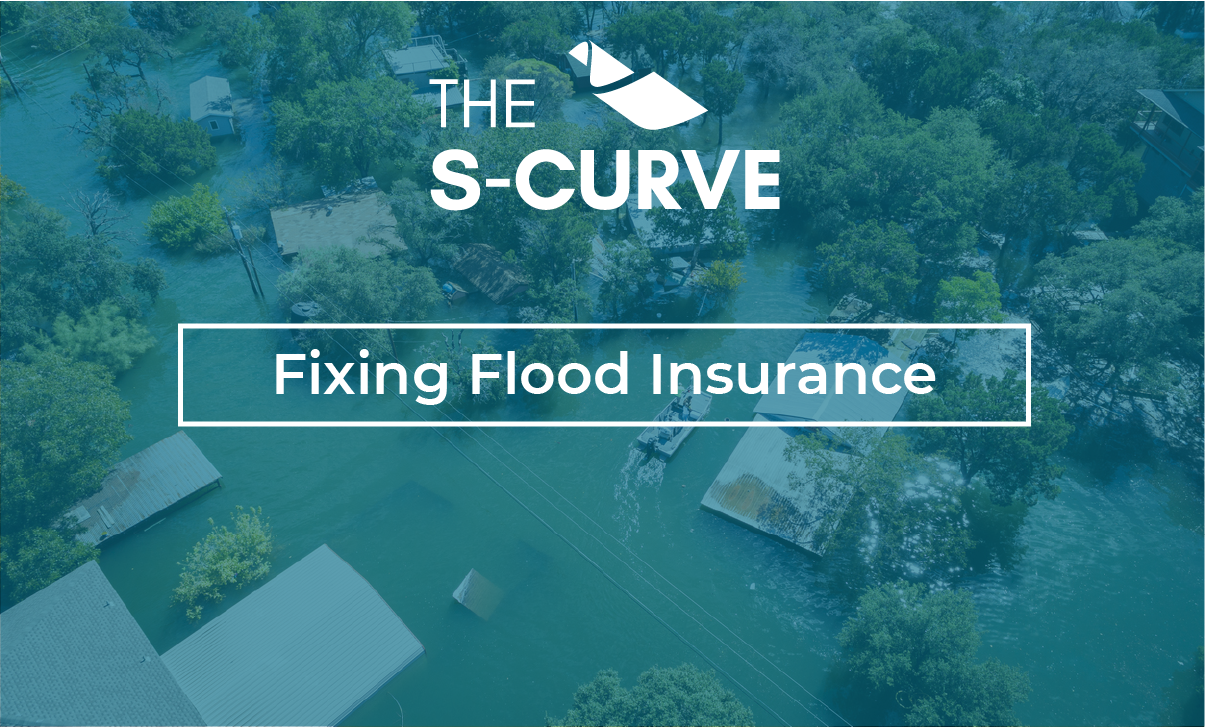 Fixing Flood InsuranceThoughts
In this short blog post I discuss some developments taking place in the flood insurance landscape in the US and look ahead at a few potential directions things could go. I suggest that universal catastrophic flood insurance coverage with a continuation of the introduction of risk-based pricing would be a significant improvement.
Background
FEMA’s NFIP, which is required by lenders on at-risk properties, has a cap of $250,000 per property on residential properties and has recently evolved. This evolution has introduced risk-based pricing and will result in drops in many policy premiums (about 1.1 million properties) but also large increases (which will be phased in over years) in those of higher risk properties (about 200,000). FEMA is in the process of transitioning from using lagging flood zone maps to using commercial software similar to that used by the reinsurance industry for the purposes of pricing this risk. This has been covered in multiple articles recently in the media, as well as the topic of rising homeowner’s insurance policy premiums, which have been growing faster than inflation (since homeowner’s policies cover replacement value of homes, any increase in the cost of building materials would naturally show up in replacement cost, so inflation could be expected to pass through to homeowner’s premiums).
Somewhat less known is that FEMA has also been purchasing reinsurance since 2016. In 2021, the NFIP bought $1.15 billion in coverage from 32 private insurers. Additionally, in 2018 FEMA began to use the catastrophe bond market to also tap the capital markets for reinsurance, with the FloodSmart Re shelf. Including 2021 issuance, total coverage in place through catastrophe bonds is $2.9 billion.
Private flood insurance is also growing. In 2021, 58 private firms were writing flood insurance, with 2020 total gross premiums collected over $730 million. Between NFIP and private firms, the percent of homeowners surveyed by the Insurance Information Institute stating that they had some form of flood coverage has risen from 12-14% to a recent high of 27%.
Looking Ahead
To observers familiar with the mortgage market, the early moves made by NFIP appear similar to the introduction of loan-level pricing adjustments to differentiate borrower-level credit risk, and the creation of the CRT market to lay off portfolio credit risk using a combination of reinsurance and capital markets. However, the largest concern at this point in time is that there is no requirement to have coverage – unless the lender has identified the subject property as at-risk (the GSEs, for example, currently only require it for properties defined as at-risk based on the legacy FEMA flood map system, which means that at best the information used to make this determination is a decade old). This also means that as climate change increases inland flooding patterns and frequency, which is much less covered by legacy maps, a lot more homeowners are potentially at risk. It is worth taking a look at what other countries do.
Two basic approaches appear to exist in other developed countries. Under the first, homeowner’s have the option of extending their regular homeowner’s policy to cover flood. This approach is taken, for example, in Germany and Italy. Drawbacks of this approach are that because it is optional, only homeowners at higher risk take it up, and therefore it tends to be rather expensive. It also means that homeowners who underestimated their risk (which is more likely going forward due to the changing climate) are likely to find themselves self-insuring when they need it.
The second approach, taken by Spain, Japan and the UK, requires home insurance to include wind, fire and flood. The upside of this approach is that everyone is covered. While it increases everyone’s premiums, the increase is small for most homeowner’s and spreads the risk over the entire population. This approach doesn’t preclude the use of risk-based pricing, but instead sets a minimum level of flood coverage premium for every home – even those in areas that have never recorded flooding, but may in the future (given that rainfall patterns as well as the built environment is changing, future flooding may be less predictable using past flooding data).
Our system in the US shares a similarity with this second system, but it is hidden. NFIP has been operating at losses for a significant length of time and has been subsidized by Congressional appropriations, which are ultimately owed by the taxpayer. This means that losses beyond premiums collected is already socialized. Additionally, the lack of extensive coverage means that there are two sorts of uncovered losses. A typical low-grade flood event seems to result in losses in the $10-20,000 range, which one can imagine many homeowner’s managing to cover from personal resources (though many might also struggle). However, the largest disasters, such as hurricanes, result in average losses over $100,000. At this point the Federal government usually appropriates disaster funds. This is why, so far at least, these disasters have resulted in rebuilding and house price recovery more often than they have resulted in house price declines. This is the second form of socialization of losses.
It is important to point out that under this hidden system of universal coverage, both efficiency and equity suffer. In economics there is usually a trade-off between efficiency (which comes from allowing price signals to reach buyers to disincentivize risky behavior) and equity (subsidizing those who have the least). In this case, everyone is subsidizing those in flood-prone areas, many of which are higher-income vacation and second homes.
We can compare this approach to socialization of losses with a policy of universal flood insurance as a requirement towards obtaining a mortgage. Every homeowner would pay some minimum level of flood insurance premium. This could be for a catastrophic policy, meaning with a sufficiently high deductible that the policy would only payout when something truly disastrous happens, that a typical homeowner would be very likely to struggle with on their own. In contrast to the hidden universal system, higher risk properties would have substantially higher premiums, in some cases high enough to impact affordability. This would create an important price signal, indicating to a potential buyer that there is something to pay attention to in this location. Better yet would be a system similar to equipping a potential adjustable-rate mortgage (ARM) buyer with both a payment schedule based on current interest rates and one based on hitting periodic and life caps – disclosing not just current insurance premiums but the projected path of future insurance costs if they were to acquire that property. This would address the considerable informational asymmetry that exists in real estate markets, between developers and sellers, who know the area well, and buyers, who may be new to the area.
Right now, there is very little transparency with regard to future costs in owning a home beyond the mortgage payment schedule. The lack of insight into future insurance premiums is compounded by the potential for rising property tax assessments in the very places that also have high exposure to climate-driven natural risks. This is because the highest risk locations also face significant risk to their public infrastructure, which is funded by state and local taxes, often heavily reliant on property taxes. A universal requirement for flood insurance and risk-based pricing of that insurance would be an important step to improving this transparency.
Further Reading: https://www.iii.org/article/spotlight-on-flood-insurance
The S-Curve Archives
-
Thoughts
Summary
In 2021, Andrew Davidson & Co. Inc. (AD&Co) proposed a benchmark cohort approach to setting Ability-to-Repay (ATR) Qualified Mortgages (QM) standards. Successful benchmarks based on data are model-free and transparent, and the cohorts must perform consistently in comparison to one another and across time. Our original work used data through the early stages of the pandemic when non-performing loan percentages skyrocketed.
-
 Thoughts
How Lowering Capital Costs Affects Higher-Risk Loans
Government-sponsored enterprises (or GSEs) are companies that provide guarantees and financing to originators through the mortgage secondary market. The size and resilience of the GSE secondary market maximizes diversification and liquidity which reduces financial risk and cost of capital. This benefit accrues to conforming borrowers through lower mortgage rates and resiliently available financing.
-
 Products
The release of Andrew Davidson & Co., Inc.’s (AD&Co) new generation of financial engineering tools marks a shift to a new reality; when the traditional benchmark for MBS valuation, the LIBOR/ Swap yield curve, becomes unavailable. Our recent Product Release email informed our readers about the change. In short, our users can:
-
 Thoughts
FHFA held a listening session for interested parties on its proposed rule on the GSE process for credit scores. The objective is making mortgage underwriting and pricing more accurate and more fair while balancing practical implementation by firms in the mortgage ecosystem. Along with many others, I had the opportunity to provide insights on this proposed rulemaking.
-
 Thoughts
In our January 19th blog entitled, A More Equitable Lending System Will Not Be Created by Accident, we described the efforts it will take to overcome not just bias in lending today, but the systemic factors that have limited access to credit in the past and have created an unjust system.
-
 Thoughts
In this short blog post I discuss some developments taking place in the flood insurance landscape in the US and look ahead at a few potential directions things could go. I suggest that universal catastrophic flood insurance coverage with a continuation of the introduction of risk-based pricing would be a significant improvement.
-
 Thoughts
Introduction
The Government-Sponsored Enterprises (GSEs) entered conservatorship in September 2008. One could view the succeeding thirteen years as a journey back to financial stability with a refined operating model that looks more like a financial utility than a hedge fund. This business model is more compatible with a fair lending mission for a standard-setter that maintains secondary markets under an effective regulator. The GSEs remain the largest part of the housing finance backbone and a resilient funding source during economic stress.
-
Thoughts
Around 75% of white American families were homeowners in the first quarter of 2020, according to data from the United States Census Bureau. However, only 44% of Black American families owned their homes at the same time.
-
Thoughts
According to a report by the Research Institute for Housing America, climate change risk is rapidly increasing in the housing industry and will continue to demand more attention and regulation in the near future.
-
Thoughts
Mortgage market participants are keenly aware that the Federal Reserve has been scaling back its UST and MBS purchases and factoring the outcomes of its actions on stakeholders across markets.