

Welcome to The S-Curve
Now you will be able to receive the latest announcements, product updates, and our insights on the mortgage market in real time.
The name of the blog, the S-Curve, is a reflection of our logo and the central feature of our prepayment model. S-curves are seen in nature in many phenomenon, from population growth to prepayment and default models. Our first S-curve, in the early 1990s, used the arctangent function, then piece-wise linear functions, and evolved over time to be more complex and vary by FICO, loan size and LTV. This evolution encapsulates both the timeless nature of fundamental relationships and constant innovation to describe them better over time.
We hope you find the information useful and we look forward to your feedback.
-
The GSEs as Regulated UtilitiesThoughts
In the spring of 2019, National Association of Realtors® (NAR), together with financial-market experts Susan Wachter (Wharton) and Richard Cooperstein (Andrew Davidson & Co., Inc.) proposed completing the transition of Fannie Mae and Freddie Mac (Enterprises) into market utilities in a publication entitled “A Vision for Enduring Housing Finance Reform.” This work builds on Richard Cooperstein and Andrew Davidson’s 2017 paper, “ Is There a Competitive Equilibrium for the GSEs?”
In NAR’s latest white paper, “GSEs: Their Viability as Public Utilities,” Wachter and Cooperstein expand on several points in their earlier discussion. On January 14, 2021 at 1:30 PM ET, NAR is hosting a webinar open to all interested parties to further explore and discuss these insights.
Why a Utility?
Fannie and Freddie were established by Congress as private companies with a public mission; namely, to support secondary market liquidity and mortgage access at all times, across the entire country, with a special obligation to support underserved markets. The mortgage origination and capital investment markets are highly competitive and efficient, but the guarantor and securitization markets are not. These markets function better with externally imposed standards for quality, consistency, capital adequacy and fairness. Further, scale is required to achieve these goals. These are the characteristics of public utilities.
The common governance structure for utilities is private companies with service obligations and strong regulators that ensure adherence to the mission and to regulate returns. The cost of capital is by far the largest component of the GSE risk fee, so reducing the unsubsidized cost of debt and equity is the most effective way to reduce consumer cost and advance homeownership. Financial theory and 100 years of empirical evidence show that government-granted franchises that operate in limited markets have lower return volatility and thus lower required returns on equity and debt. Indeed, the beta for utility stocks is half that of the S&P 500.
Three requirements for success are: (1) The GSEs curate stable debt markets for interest rate and credit risk and to intermediate most of their risk into these competitive capital markets. (2) A federal backstop on pass-through debt (MBS) and corporate financing for approved activities such as Cash Window operations and non-performing loan buyouts, but not for equity holders or credit risk securities. And (3) A governance structure that balances the tension between regulation, mission and capital markets discipline with a regulator, board, shareholders and management. At this stage, the regulator and operating model are largely in place, it remains to establish a Board that represents shareholders and other constituents, and shareholders.
The S-Curve Archives
-
 Events
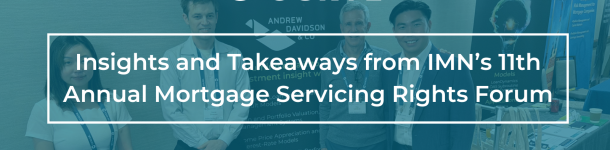
Andrew Davidson & Co., Inc (AD&Co) proudly sponsored IMN’s 11th Annual Mortgage Servicing Rights (MSR) Forum by Informa at the New York Hilton Midtown. Senior modeler Daniel Swanson joined the “Managing Delinquencies & Forbearance Value” panel in discussing how servicers are adapting to today’s market and the evolving delinquency trends.
-
 Podcast
Tune in to our fourth episode of AD&Conversations with Kevin Lin and Eknath Belbase, our product lead for our Climate model. In this episode, they discuss the new Climate Impact Suite (CIS) pilot project, and Belbase outlines several challenges the team is navigating, including:
-
Podcast
Tune in to our fourth episode of AD&Conversations with Kevin Lin and Eknath Belbase, our product lead for our Climate model. In this episode, they discuss the new Climate Impact Suite (CIS) pilot project, and Belbase outlines several challenges the team is navigating, including:
-
Podcast
Andrew Davidson was invited to speak on Equifax's Market Pulse Podcast titled, "Driving Efficiency and Resilience in the Mortgage Industry" live at the 2025 MBA Annual Convention in Las Vegas.
Andy explains how variations in data files can distort risk assessment, creating a dual risk for lenders: extending credit to borrowers more likely to default while overcharging customers whose risk is overstated.
-
 Thoughts
Our latest Policy Perspective written by Richard Cooperstein offers an analysis of the U.S. housing and mortgage finance markets, focusing on key trends and forward-looking risks. While housing markets are not fully efficient, they do respond to economic imbalances which create opportunities and vulnerabilities. This article explores how demographic shifts, credit access, interest rates, and climate risks shape both housing demand and supply.
Key findings include:
-
Podcast
Join Kevin Lin in a conversation with Richard Cooperstein as they dive into Kinetics, AD&Co's modular platform designed to deliver the full power of our models and analytics; with the flexibility to license only the tools you need.
-
Thoughts
The latest Policy Perspectives paper “Competing Claims in Privatization of Fannie Mae and Freddie Mac” is now available!
Nearly 20 years ago, on September 6, 2008, the GSEs, Fannie Mae and Freddie Mac entered conservatorship. Since that time there have been many proposals to restructure, eliminate or release the GSEs. Once again there is talk about the privatization of Fannie Mae and Freddie Mac.
-
 Thoughts
AD&Co held our annual employee meeting in Detroit, Michigan. In addition to gathering everyone in person to socialize and strategize, we use these annual meetings to learn about different cities, especially with regard to housing market dynamics.
We chose Detroit because the oft-maligned city is undergoing a significant renaissance, and we wanted to explore the area and learn how housing may have played a role in both Detroit’s decline and rebirth.
-
 Products
Andrew Davidson & Co., Inc (AD&Co) is pleased to announce the beta release of MARS+, the next generation of Mortgage Analysis & Reporting System (MARS), which has been in use since 2008 for performance reporting of AD&Co models. MARS+ aims to provide enhanced and advanced capabilities and features for mortgage analysis and reporting.
The new enhancements of MARS+ include:
-
 Events
Several AD&Co employees attended SFVegas 2025. This post shares their unique perspectives from attending the conference and key takeaways from the sessions.