

Welcome to The S-Curve
Now you will be able to receive the latest announcements, product updates, and our insights on the mortgage market in real time.
The name of the blog, the S-Curve, is a reflection of our logo and the central feature of our prepayment model. S-curves are seen in nature in many phenomenon, from population growth to prepayment and default models. Our first S-curve, in the early 1990s, used the arctangent function, then piece-wise linear functions, and evolved over time to be more complex and vary by FICO, loan size and LTV. This evolution encapsulates both the timeless nature of fundamental relationships and constant innovation to describe them better over time.
We hope you find the information useful and we look forward to your feedback.
-
 Introducing the Kinetics Multifamily LoanDynamics ModuleProducts
Andrew Davidson & Co., Inc. (AD&Co) is pleased to announce the official release of Kinetics v1.10, the latest update to AD&Co’s modular platform for running the AD&Co suite of analytics. This update introduces the Multifamily LoanDynamics Module, the newest way to run Multifamily LoanDynamics Model (LDM). Investors, servicers, insurers and lenders can leverage this new module to better understand the prepayment and credit risk of their multifamily mortgage portfolio.
The Multifamily LoanDynamics Module joins MSRKinetics, PoolKinetics, the LoanDynamics Module, and the Auto LoanDynamics Module on the Kinetics platform. With this release, all flavors of LDM (Agency, Non-Agency, Auto, and Multifamily) are supported in Kinetics.
Kinetics v1.10 also includes enhancements to the LoanDynamics Module for single-family mortgages, including support for global tunings, a new Lifetime Results report with metrics such as WAL and lifetime CPR, and integration with the latest version of LDM: v3.0.3 patch 1.
Users can access the Multifamily LoanDynamics Module via the Kinetics desktop application (Windows), a web browser, or integration with the Kinetics REST API. AD&Co can provide a developer kit to those interested in integrating the Kinetics Web Service with their proprietary system.
Ready to schedule a demo of Multifamily LoanDynamics Module? Contact us to get started.
 Multifamily LoanDynamics Module Portfolio
 Multifamily LoanDynamics Module Custom Prepayment Penalty Points
 Multifamily LoanDynamics Module Results
 -
 Takeaways from Lessons Learned: Insights for Managing the Interest Rate Risk of BanksEvents
Andrew Davidson & Co., Inc. (AD&Co) held a webinar on June 8th entitled “Lessons Learned: Insights for Managing the Interest Rate Risk of Banks.” Mickey Storms from our Alliances and Policies team, Alex Levin from our Financial Engineering team and Andrew Davidson were featured speakers.
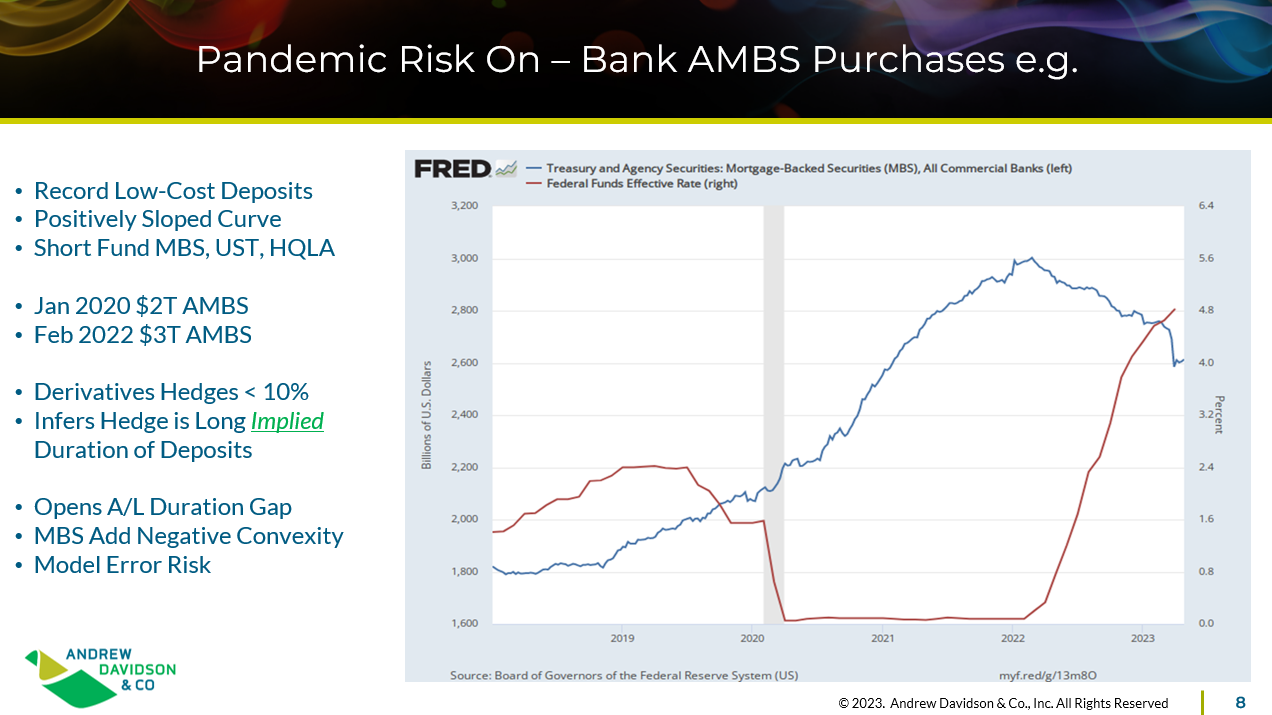
Mickey revisited interest rate changes since the onset of the pandemic and showed how these led to changes in appetite for yield curve risk at banks as interest rate declines compressed their Net Interest Margins (NIM) as depicted in the slid below. He went on to show how this appetite conveyed a questionable sense of comfort by banks that the Assets and Liabilities (A/L) duration gap would not be problematic in the future. The example presented was the strategy of increased short funding of MBS with deposits as rates fell during the pandemic, the success of which depended on an implied long duration of deposits to conceive of a manageable duration gap between A/L. He went on to show the significant duration that exists on the asset side of bank balance sheets and that in the absence of hedging, the success of short funding strategies relies critically on the behavior and duration of deposits whose behavior has changed recently. Mickey closed by pointing out that there has been a lack of regulatory focus on Interest Rate Risk (IRR) in recent years that accommodated banks taking interest rate and duration risk at U.S. Banks.
Alex considered several important methodological challenges in measuring IRR and the A/L duration gap. He began with the asset side and explained why an empirically developed prepayment model is not sufficient to fully capture AFS assets’ market sensitivities. For the purpose of replicating those sensitivities, a prepayment model needs to be “risk-neutralized” with faster refinancing and slower housing turnover – the main feared directions of the prepay-model risks. A risk-neutral model would better track market sensitivities of premium and discount assets, as illustrated by the dynamics of different duration measures during 2022 (a similar pattern observed across the TBA coupon stack).
As a risk-neutral turnover rate is slower than an actually observed one, the currently outstanding MBS portfolios (and most banks’ assets) are longer (duration-wise) than many people think.
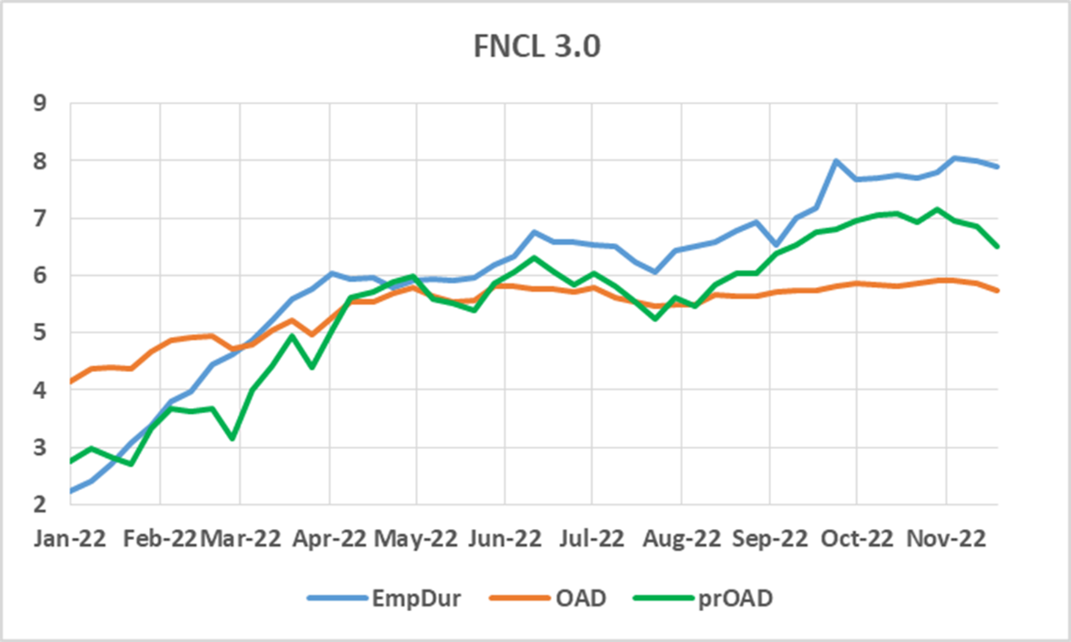
Comparative Duration Measures
OAD – Option-adjusted duration utilizing empirically developed prepay model
prOAD – Option-adjusted duration utilizing risk-neutralized prepay model
EmpDur – Empirical 60-day sensitivity measured from the daily moves of TBA price and 10-yr rate (model-free)Alex discussed the role of Non-Maturing Deposits (NMD). While an empirically defensible model of retention and paid rate is a good start, many external factors are typically not evident from historical data. Those include possible changes in the deposit base or media/bad press effects that could shorten the duration of NMDs. Therefore, A/L duration gaps are likely to be wider than ones measured.
Alex demonstrated a Net Present Value (NPV) analysis of a hypothetical bank with assets, term liabilities, and NMDs. He constructed a TBA-13-type of NPV of equity profile for two cases:
- NMDs are intact (chart on the left below)
- NMDs are replaced with par-valued liabilities having no intangible value to the bank (chart on the right below).
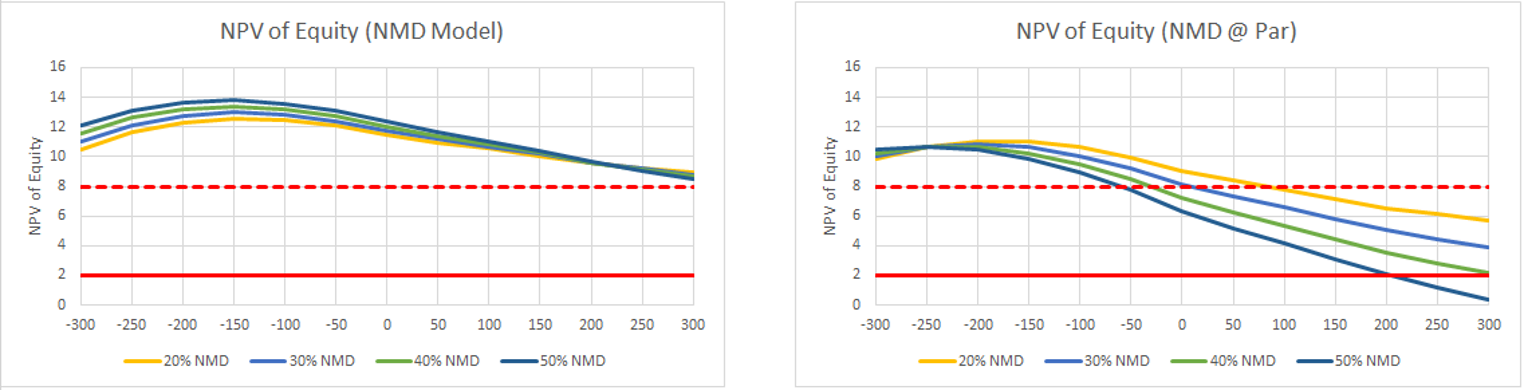
This exclusion of the economic value of NMDs from the NPV consideration is a useful stress-test we recommend banks conduct.
A bank’s hesitation to hedge IRR is commonly linked to a loss of NIM under the commonly steep yield curve. Under the current inversion, swaps have a positive carry that would improve NIM while closing (or even inverting) the duration gap. Alex demonstrated the use of a 3-year SOFR swap that would make the same bank duration-neutral while adding 50 bps of NIM or even inverting the IRR exposure while adding 100 bps of NIM.
Andy closed by dimensioning the two-way risks that exist with respect to future interest rates and the shape of the yield curve and pointed out how this may impact the dynamics of other assets and businesses that banks maintain. Among these were mortgage servicing and origination. He addressed bank risk management board roles, policies, procedures and controls and discussed the critical importance of an open culture with respect to risk insights and tactics. The review of models and scenarios used to manage IRR was also presented, as was the importance of asset diversification and capital allocation processes that include risk limits. He closed by talking about Basel 2 IRR analytical methods and how focusing on economic value, earnings and market are essential to effective IRR management.
Click here to view the presentation and webinar recording.
-
 Introducing a New Report Series on Specified Pool Prepayment TrendsProducts
Andrew Davidson & Co., Inc (AD&Co) is pleased to announce the beta release of a new monthly report series titled “Specified Pool Prepayment Trends,” which aims at showing market prepayment trends for specified agency pools in support of pay-up analyses by investors, traders, and alike.
The reports in the beta release include 30-year Fannie Mae, Freddie Mac and Ginnie Mae II collateral and provide 1-, 3-, 6- and 12-month prepayment speed differences for specified pools in comparison with the overall prepayment speed of each corresponding, non-specific coupon cohort. The specified pools covered in the beta reports include only the pools defined by loan size buckets.
The following snapshot is a sample report table where the "All" column shows the average prepayment speed for each non-specific coupon cohort. For each specified pool defined by a loan size bucket, the report shows the difference in prepayment speed between the specified pool and the "All" column. Faster speeds than the corresponding coupon cohort are shown as positive numbers. Cells under each specified pool label are also colored using the color legend shown below.
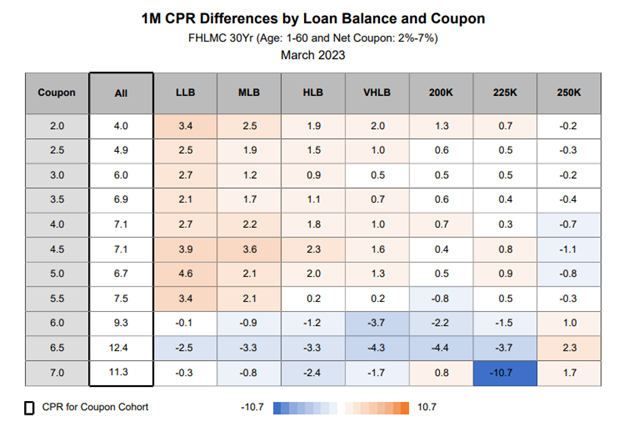
While each report provides a monthly reference point for pay-up analysis, a sequence of monthly reports may also have the potential to observe and track changes in mortgage prepayment speeds under different macroeconomic conditions.
During the beta period, we will continue to enhance and enrich the “Specified Pool Prepayment Trends” reports. We look forward to your comments, suggestions and feedback to make these reports more informative and useful to you.
Please contact us at support@ad-co.com or (212) 274-9075 with any questions or suggestions.
-
 Auto LDM Available in PolypathsProducts
Andrew Davidson & Co., Inc (AD&Co) is pleased to announce that Polypaths LLC supports AD&Co’s Auto LoanDynamics Model (Auto LDM) providing prepayments, defaults and losses on auto loans and securities.
It is imperative in today’s ever changing economic environment to assess and manage financial risk. Polypaths’ integration of AutoLDM, in conjunction with their market leading solutions, allows users to analyze auto loans and securities when implementing risk and portfolio management strategies.
AD&Co is excited to introduce readers to Pathways, Polypaths’ monthly newsletter which features news and updates related to recent product enhancements, upcoming webinars and other events, along with a detailed case study focused on a particular question or exercise. Pathways Issue No. 43 provides readers with a case study discussing their support of auto loans and securities.
Current subscribers of Pathways can access Issue No. 43 here: https://polypaths.com/clientarea/pathways/. If you would like to subscribe and receive a set of credentials for Pathways, please contact support@polypaths.com.
-
 Mortgages at SFVegas 2023Events
The Structured Finance Association hosted SFVegas 2023 (February 26 - March 1), a broad capital markets conference with thousands of attendees in Las Vegas. Andrew Davidson & Co. Inc. (AD&Co) was a sponsor focused on the mortgage sector. As we engaged with clients and policy leaders, a few themes emerged: Data, Expanding Access Safely, Ginnie Mae Servicing and Auto Loan Performance.
Data
Well-managed data is the underpinning of well-run mortgage organizations, supporting efforts to manage risk, profitability, and compliance. Data is essential to developing new products, improving accuracy, and expanding access to mortgage finance. Nearly everyone we spoke to spends time and money on data and still struggles to manage it through their internal operations, from loan level acquisition to portfolio management and reporting. They expend additional effort to acquire and pass on data in the larger mortgage ecosystem. The richness and reliability of data degrade even within companies, let alone as mortgage-related assets pass through the value chain. This degradation worsens the information asymmetry between sellers and buyers, increasing risk and pushing the mortgage business further from an efficient market. It impedes adding new data to the data-frame, such as the new Trended Credit Scores or expanded data generally, that helps expand markets.
These realities align with the economic theory of imperfect markets and utilities. Markets that provide gains from scale and consistency have attributes of public utilities. Adding privacy concerns and positive systemic value beyond individual mortgage transactions do as well. Reducing the inherent information asymmetry between sellers and buyers further suggests that the efficient market outcome could be a regulated market utility of loans and related data. Data aggregators can supply to the utility, and data consumers can access it.
Expanding Access Safely
Safely expanding access to mortgage finance is not automatic. The legacy of discrimination generally and in housing finance specifically, shows up in the persistently lower homeownership rates of minority populations. Homeownership rates can be expanded temporarily by lowering standards and raising risk, or durably by using new data that lowers risk. Making progress requires commitment and solving the data market failure described above.
Ginnie Mae Servicing
It’s well known that compliantly servicing non-performing loans can cost several times the fixed servicing fee and thus pose systemic risk. During the Pandemic, Federal agencies scrambled to provide financing and reduce the burden on non-bank servicers that represent a substantial majority of the Ginnie Mae market without the federal backing that most of the mortgage ecosystem enjoys. This cost-revenue imbalance is not an advancing issue and cannot be solved by transferring the burden of advancing NPL payments to bond holders. The market bid for Ginnie Mae servicing in mid-2020 was zero because of the expectation of high NPL rates. Fortunately, record low mortgage rates and record refinancing volume provided servicers who were also originators with cash flow to offset the cost of servicing FHA NPL rates that temporarily reached 14%. The next time there is a systemic rise in delinquency rates, this extra cash flow is unlikely.
What’s the solution for this? The most straightforward solution is a variable servicing fee that aligns revenues with expenses, but there is surprisingly little enthusiasm for this solution. Ginnie Mae’s leadership is clearly aware of the systemic risk potential and is seeking a solution. The U.S. mortgage market often uses a federal backstop behind private financial markets to provide the stability the economy depends on. The backstops of deposit insurance or for the GSEs are examples. We will be studying this issue.
Auto Loan Performance
For the first time in awhile, attention is being paid to rising auto loan delinquency rates, both prime and subprime. Ordinarily, today’s historically low unemployment rate would associate with low delinquencies, so this rise is worrisome. It’s well-known that supply-chain disruptions during the Pandemic caused spikes in new and especially used car prices. Cars financed at those high prices pose more risk, and used car prices have already dropped about 15% from their peak. AD&Co will be monitoring this performance and refining our models.
The S-Curve Archives
-
 Thoughts
The earliest paper we found examining the impact of climate risks on house prices was from 2017, which found a relationship between elevation/sea level rise and house price differences.[1]
We built our climate-conditioned HPA model in 2022 based on the idea that an increase in insurance costs would impact house prices (something we had not studied yet) in the same way that an increase of the same size in mortgage rates would impact house prices (something that we were quite familiar with).
-
 News
NewsAndrew Davidson & Co., Inc (AD&Co) is pleased to announce a new alliance with Mortgage Capital Trading, Inc. (MCT), a leading provider of mortgage capital market solutions.
-
 Events
At Andrew Davidson & Co., Inc. (AD&Co), our dedication to Diversity, Equity, and Inclusion (DEI) has been a cornerstone of our values. We established our DEI Committee in 2020, following the tragic murder of George Floyd. Despite the evolving landscape, including the recent U.S. Supreme Court decision impacting affirmative action in higher education, we remain steadfast in our commitment to fostering an inclusive environment that strengthens both our employees and the company.
-
 PodcastTune in to Eknath Belbase's interview with Michelle Stepien Breier & Richard Cooperstein as they discuss their latest Pipeline article “Improving Mortgage Data: A Data Exchange for the Mortgage Ecosystem.”
 -
 Events
Andy and I recently attended AmeriCatalyst ‘Going to Extremes’ Climate, Housing and Finance Leadership Summit in Washington, D.C., a fantastic conference on all things related to climate risk and the housing ecosystem. While going over all the great speakers and broad expertise represented there would take a novella, I want to connect a few key ideas discussed there to our ongoing efforts in this area.
-
 Events
At the recent AmeriCatalyst ‘Going to Extremes’ Climate, Housing and Finance Leadership Summit, I presented a session on how risks related to weather-related losses impact the housing finance system.
-
 Products
Andrew Davidson & Co., Inc (AD&Co) is thrilled to announce an expanding relationship with a Third-Party Vendor! AD&Co enjoys working with countless analytical providers to offer our clients seamless solutions and we would like to welcome Milliman M-PIRe™ to the team!
-
 Events
The Federal Home Loan Bank of San Francisco directed the Urban Institute to develop innovative and actionable ideas to close the gap between white and black homeownership rates, which is as wide today as before the Fair Housing Act, enacted 60 years ago. Homeownership is crucial to a fairer society because working and middle-class families most commonly create inter-generational wealth by owning homes with amortizing mortgages.
-
 Events
The Data Foundation of Mortgage Finance
Homeownership is the largest source of wealth accumulation and inter-generational wealth transfer for the working and middle class. However, the non-interest cost of financing is always an obstacle for first-time and low-wealth buyers, and underserved populations.
-
 Thoughts
In this blog post, we used the recently updated Mortgage Market Statistical Annual to examine the dynamics of residential loan origination by state and by market segments and highlight important trends.