

Welcome to The S-Curve
Now you will be able to receive the latest announcements, product updates, and our insights on the mortgage market in real time.
The name of the blog, the S-Curve, is a reflection of our logo and the central feature of our prepayment model. S-curves are seen in nature in many phenomenon, from population growth to prepayment and default models. Our first S-curve, in the early 1990s, used the arctangent function, then piece-wise linear functions, and evolved over time to be more complex and vary by FICO, loan size and LTV. This evolution encapsulates both the timeless nature of fundamental relationships and constant innovation to describe them better over time.
We hope you find the information useful and we look forward to your feedback.
-
 Introducing the Kinetics LoanDynamics ModuleProducts
Andrew Davidson & Co., Inc (AD&Co) is pleased to announce the official release of the LoanDynamics Module in Kinetics, AD&Co's new modular platform for running AD&Co analytics via a desktop application, web browser, or REST API. The LoanDynamics Module is the latest way to run the LoanDynamics Model, allowing users to perform sensitivity analysis, validation testing, and scenario analysis in a modern, user-friendly application. The LoanDynamics Module supports all flavors of single-family LDM (Agency, Agency Plus, Non-Agency) and is an alternative to the LDM Excel Spreadsheet.
Users can access the LoanDynamics Module via the Kinetics desktop application (Windows) or a web browser. A developer kit is also available for those who would like to integrate the Kinetics Web Service with their proprietary system.
The LoanDynamics Module joins MSRKinetics and the Auto LoanDynamics Modules on the Kinetics platform. Later on, the Multifamily LoanDynamics Module will become available, allowing users to run agency multifamily loans and securities on Kinetics.
AD&Co always looks forward to your comments and welcomes feedback from frequent users of the LDM Excel spreadsheet, who may have perspectives that will help us improve the new application.
Ready to take the LoanDynamics Module for a spin? Contact us to get started.
 LoanDynamics Module Portfolio
 LoanDynamics Module Scenarios
 LoanDynamics Module Results
 -
 New Scores in Mortgage ModelsThoughts
Recently the Federal Housing Finance Agency (FHFA) announced some upcoming changes related to the use of new credit scores, FICO 10T and VantageScore 4.0 by Fannie Mae and Freddie Mac. “FHFA expects that implementation of FICO 10T and VantageScore 4.0 will be a multiyear effort. Once implemented, lenders will be required to deliver both FICO 10T and VantageScore 4.0 credit scores with each loan sold to the Enterprises”.[1] This announcement will impact the entire mortgage ecosystem.
In this blog, I will discuss some of the challenges that come with transforming the analytical models used to value and manage the risk of mortgage loans and securities. Behavioral models are used to forecast the probability of prepayment, delinquency, default, and losses given default. Credit scores are typically inputs into these models. The models in use today are all calibrated using the classic FICO score.
Getting the models ready to run with FICO 10T and VantageScore 4.0 will mean that every single model using these scores will have to be refitted, tested, and validated before they can be put into production. Let us look at what all this entails.
Two populations will be affected by this change:
- Population of new loans
- Population of existing loans and securities
Let’s start with the first population. All new loans will have to be analyzed using FICO 10T and VantageScore 4.0, which means that any origination or risk models for these loans will need to be estimated using the new scores. Underwriters will need to understand the nuances of the new scores and will probably need a mapping from old scores to new scores.
For the second population, we will need to refit the existing prepayment and credit models used by the industry. The new models should take the new scores as inputs. We will need historical data for FICO 10T and VantageScore 4.0 going back at least to the financial crisis of 2008, along with the loan and collateral information. Having data from various economic cycles will be important to parametrize the models with the new scores and validate the sensitivity of the various factors in the models that use the new scores. It would be good to have data from the period leading up to and following the crisis. Pre-crisis will let us quantify the “bad” loans that led to the crisis, whereas post-crisis will let us quantify the delinquencies, defaults, and losses. We also need data for periods when rates went down and when rates went up. With its historically low rates, the pandemic period is a unique period and probably less important from a historical perspective.
Trended data gives us information about a borrower's financial position or liquidity at a given time. A borrower who pays the minimum payment on their credit card debt is called a “Revolver,” while a borrower who makes a full payment is called a “Transactor”. A limitation of the trended data available today is that some major credit card issuers do not report the trended information to the bureaus, which means that the trended scores would have limited training data sets. Is there a way to overcome this bias? Utility data is also not readily available for most borrowers. Fannie Mae and Freddie Mac are now using rental data, but there is no good source of rental data for industry participants.
As we look at new scores, we should also consider how the scores can be made more useful. We know that a borrower’s trended data affects every loan transition throughout the loan lifecycle. Loans could transition from being Current to Delinquent to being Seriously Delinquent to becoming Real-Estate Owned (REO) and finally terminate (and could also transition to prior states). These loan transitions have increased predictive power if we use trended data. The question is, how can industry participants use this information?
This will be a multi-year effort for the industry. It would be better if, for the population of existing loans (about $11 Trillion), we could find an easy way to bridge the existing scores with trended and utility data. Also, as we start using rental, utility, and telecom data, we will have previously unscored loans coming into the ecosystem. There will be a need for frequent model updates as we get additional history about the behavior of these borrowers in various stress environments.
A solution is to use the classic FICO score and use other variables that are orthogonal to the classic FICO score to obtain metrics that are much more predictive through the entire loan lifecycle. A benefit of doing it this way is that we can use loan and collateral information which is not available in a credit score alone. For example, LTV or loan-to-value significantly impacts borrower behavior in stress situations.
We currently do not know a lot about the transition pathway to FICO 10T and VantageScore 4.0 in models used by the mortgage industry. However, one thing is clear. It will take many years before the market is positioned to utilize the advances in analytics coming from new data and new models.
A big question for all market participants is, who will provide the historical data required to recalibrate the models? It is not enough to just have access to the new scores. There should be a way to merge the scores with the collateral and loan data. Fannie Mae and Freddie Mac would be good sources for loans sold to the enterprises, but we would also need data for FHA/VA loans and loans held in bank balance sheets. Also, for the agencies, we would need data for all loans and not just for the loans in the CRT (Credit Risk Transfer) reference data set.
We at Andrew Davidson & Co., Inc. have been working with trended data from Equifax and have found interesting ways to link our prepayment and credit models with the available trended data. It is almost like the next frontier in mortgage prepayment and credit modeling. Models evolve with the availability of new data. Bringing borrower credit bureau data into the modeling process will help us understand and forecast borrower behavior in a much more meaningful way.
[1] https://www.fhfa.gov/Media/PublicAffairs/Pages/FHFA-Announces-Validation-of-FICO10T-and-Vantage-Score4-for-FNM-FRE.aspx
FICO 10T, VantageScore 4.0, and Equifax are trademarks of Fair Isaac Corporation, VantageScore Solutions, LLC, and Equifax, Inc., respectively.
-
 The Power of MentoringThoughts
January is National Mentoring Month which is very appropriate since it coincides with the time when we typically set out our goals and intentions for the New Year. Organizations are embracing mentoring programs and these programs have indeed become a strategic imperative for many. There are many benefits to mentorship and it's easy enough to comprehend. The individuals involved in a mentoring relationship and the organizations that choose to sponsor a mentoring program all are likely to benefit.
For the organization, mentoring can build and strengthen the talent pipeline; help build loyalty among emerging talent; set up or help identify the next generation of talent; and build strategic alignment across silos of an organization by informally encouraging knowledge sharing across different areas. Mentoring programs have proven to be an effective tool to retain and effectively onboard talent, decrease the learning curve for critical roles, build a leadership pipeline, increase employee engagement and build networking and sponsorship. Additionally, mentorship is more frequently being used as a thoughtful tool to promote diversity, equity and inclusion by ensuring that all talent within an organization is provided with opportunities to learn from what the organization may consider to be the 'best and brightest' or simply by those who 'have been there and done that' before. Mentorship promotes diversity of thought and experience to be shared, which we are universally understanding, and recognizing is a benefit to any organization.
For the individuals in a mentorship relationship whether or not they are a part of a formal program, there is unlimited opportunity for learning, growth and development. A mentee has the benefit of getting perspective from someone who can be encouraging but also provide critical and frank feedback when needed and be instrumental in helping a mentee to increase their resiliency in the face of challenges. Mentors can help a mentee to navigate specific situations or people as well as provide sage advice on navigating a career. Solid mentorships can flourish and last for months or years.
Mentorship programs help to connect or match individuals and provide a framework that encourages confidential dialogue on a regular and consistent basis. For organizations -launching, executing and coordinating a mentorship program may seem like a daunting task but it does not need to be. Mentorship comes in all shapes and sizes - the key is to get started. Any company or association should consider providing tools and encouragement for mentorship opportunities both inside and outside of its organization as a simple way to demonstrate that they wish to invest and focus on talent. Talented employees are often looking for opportunities for personal and professional growth just as much as they are seeking promotions and compensation increases. It is important that team members believe they have access to impactful development opportunities to hone their skills and grow into their full potential. Mentorship programs demonstrate a commitment to the employee to develop in the manner they want with goals they establish.
If there is an existing program at your organization, see how you can get involved. If there is no formal mentoring program at your organization then consider helping to build one. In any case, no matter where you are in your personal or professional journey, look for a mentor. And for those of us who are senior leaders look for one or more mentees. I took much pride and enjoyment in starting up a mentorship program at my former company which had hundreds of employees from around the world participate through several "waves" of the program. In addition to opportunities within your company - there are many organizations that seek mentees to volunteer their time. American Corporate Partners (ACP) is a great one that I have had the pleasure of being a part of which helps our veterans, and their spouses prepare for professional opportunities outside of the military. GROW MENTORING is another that I have been a part of which began during COVID-19 by a young lawyer in the UK who simply wished to encourage junior lawyers and law students to connect with more experienced professionals during an otherwise isolated time. University alumni associations, professional organizations such as TechGC and many other groups have mentorship opportunities to get involved in and are always looking for volunteers.
And keep in mind that in a mentoring relationship it's not only the mentee that benefits! Mentorship builds a two-way, mutually beneficial relationship. What mentors learn and take away from mentoring their junior mentees is often priceless and may be the biggest surprise in any mentorship relationship. A good mentor should be an active and open listener. As an active listener a mentor can learn new insights, new values, and tools from their mentee including strengthening their coaching and feedback skills and make important often long-lasting relationships.
Ask most leaders if they have had one or more mentors during their career journey and the answer will undoubtedly be a resounding 'yes'. At a low cost with opportunity for high impact, it is no surprise that mentorship programs are becoming more and more popular, and more and more employees are getting involved. As you set your goals for 2023, I encourage you to seek out opportunities to be a mentor or mentee for yourself and for others.
Happy National Mentoring Month!
-
 Combatting the Effects of Algorithmic BiasThoughts
Homeownership is the largest source of wealth accumulation and inter-generational wealth transfer for the working and middle class. However, the history of racial discrimination (it was actually legal to discriminate by race in housing until the Fair Housing Act of 1968), suggests that we have a continuing responsibility to ensure fair access to housing and housing finance.
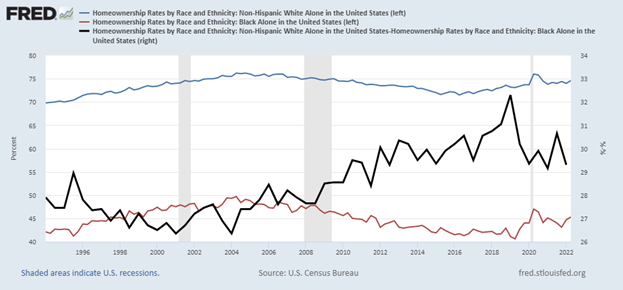
The homeownership rate for white Americans has averaged 70-75% over the last 25 years but only 40-50% for black Americans. In fact, the gap has widened over this period.
What is Equitable Housing Finance, and how do we make progress towards it?
The issues of economic opportunity, and geographic and housing inequality, are long-standing and varied. But as practitioners in mortgage risk and analytics, we focus on data, assessing risk and equal access to mortgage credit. Households of moderate means generally use credit to buy their first home so we must consider credit access and the quantitative process carefully, especially in the context of artificial intelligence and unintentionally biased algorithms.
The premise is simple: Use the same comprehensive set of financial data for everyone and apply it fairly.
Going beyond credit scores
Most people know about credit scores, which serve as the principal metric used for credit decisioning. What if it turns out that credit scores don’t reflect all relevant consumer financial data? What if this data gap has grown over time, and what if it’s larger for targeted groups like minorities and low-income families?
To the degree that mortgage decisioning models omit relevant data, they become less accurate. To the degree that such omissions are concentrated among certain groups, these models will contain algorithmic bias.
Consumer credit scores were created in the 1950s, and the Equal Credit Opportunity Act of 1974 ensured they could not include discriminatory information. The FICO formulation commonly used for mortgage credit today was built about 2004 and it correlates well to the likelihood of short-term delinquency.
However, financial data is now available that is materially relevant to consumer credit performance, but is not included in credit scores. This data is generally more significant for renters and underserved populations, those with smaller traditional financial footprints. Such indicators include consumer credit card balances, telecom/utility payment data, and free cash flow from bank accounts.
The mortgage ecosystem is beginning to work towards using expanded consumer financial data. AD&Co is acquiring this data and improving our analytics make mortgage decisioning both more accurate and more fair.
Working through public policy
Leveraging new data, advancing national standards, and broadly implementing improved decisioning are not automatic. Most mortgage lending is federally connected (GSEs, FHA/VA, banks), and compliance standards are universally applied. This occurs in part because the mortgage market contains inherent information asymmetries and social externalities around fairness and stability. The confluence of finance and policy leads us to combine our analytic efforts with actively engaging with federal counter-parties and in the policy debate. This includes focusing on how to integrate new data sources into mortgage decisioning on a national scale as a means to improve accuracy and fairness.
-
 Andrew Davidson & Co, Inc. (AD&Co) Turns 30: What’s the Definition of an Industry Pioneer?Thoughts
Dear Friends,
As Andrew Davidson & Co., Inc. (AD&Co) reaches its 30-year milestone, I reflect on two seemingly contradictory ideas: Firms need experience to guide clients through difficult times but sometimes it is necessary to discard past practices to achieve breakthroughs.
As a 30-year-old firm with many of employees having worked at the company more than ten years and several well past the twenty-year point, we feel confident that as individuals and as a firm, we have experienced a wide range of market conditions and a variety of obstacles. This level of experience is valuable when there are market disruptions, providing us with perspective on risks and opportunities. The rapidly rising rates within the last few months, mirror the rate increases of the early 1990s.
The sub-prime meltdown in 2007 was one of many historical cases where declines in underwriting quality ended poorly. Of course, each event is unique. The 1994 rise in interest rates shook the markets as new derivative products, in particular inverse floaters, caused significant disruptions. And the 2007 subprime crisis had far greater effects on the overall economy than the previous failed underwriting episodes. Neither “this time is different” nor “history repeats itself” are entirely true.
While we are proud of our company history and experience, does that mean that in 1992, the then new Andrew Davidson & Co lacked experience and hence was an unreliable partner? I would like to think that we have provided valuable advice and insights to our clients from the start. In fact, some might say that people learn too much from the past, and particularly from their mistakes. A new firm may be willing to buck tradition and find a new and better way. As a new firm we brought approaches and techniques to the investment community that were still not widely accepted. Ideas including the use of option-adjusted spread valuation, demystifying inverse floaters and showing the risk of many types of CMO structures. In fact, we had a newsletter with Tom Ho’s GAT that focused largely on debunking the claims of marketers of dubious bonds.
Which then is better? To be the new disrupter or the voice of experience? Perhaps both. Perhaps neither.
I believe the key to the longevity and success of this company has been to find the right blend of historical knowledge and testable conceptual frameworks. Even as an upstart firm in 1992, we used decades of mortgage data to develop our models. We were also students of the history of the mortgage market: from the birth of the Home Owners’ Loan Corporation (HOLC) in the aftermath of the Great Depression (including the sad history of redlining); to the rise of FNMA, GNMA and securitization, the first CMO in 1983, and the Secondary Mortgage Market Enhancement Act (SMMEA) in 1984. It was the Federal Housing Enterprises Financial Safety and Soundness Act, adopted in 1992 that set the groundwork for the rapid expansion of the GSEs and contributed to the 2007 housing finance meltdown. The study of these events helps us to understand the role of the government in both causing and addressing inequality in housing finance as well as the role of the government in promoting and interfering with liquidity in the secondary market.
We recognize that experience is essential to understanding markets, but you don’t need to live through an event to understand it. The study of history and historical data is an essential component of analyzing the mortgage market. As interest rates rise, mortgage analysts would be well advised to learn about the late 1970s and early 1980s to see how the market performed when most loans were discounts, and into the refinancing booms of 1986 and 1987 to understand how rapidly the market was transformed by refinancing; the latter period had payment rates that greatly exceed those we observed in the recent refinancing waves.
On the other hand, data alone does not always produce good analysis. In 1992, a much of the mortgage market possessed the same data we did. However, many market participants were mired in outdated ideas that did not reflect the realities of the market. Our goal has always been to combine data with financial theory. We develop models of the behavior of financial products and look to data to validate or force a reconsideration of those ideas. When a model doesn’t work as expected, that’s not the time to deny the data, but rather to look to refine or revise your thinking. In that way, we are always ready to update (or disrupt) the prior way of thinking when the evidence supports new approaches and new ideas.
We may not anticipate every change in the market, but we have a disciplined approach to keep up to date. The number of times that we have provided advice that was not taken and then led to significant losses or firm failures is distressingly high: Pipeline managers that failed to hedge interest rate and/or basis risk; insurers who managed “through the cycle” without understanding how capital markets can disintermediate them; portfolio managers who hedged duration, but not funding risk. On the other hand, the number of firms we have helped navigate difficult times provides reassurance that we have been on the right track. We have convinced some firms to give up the yield of support bonds, hedge risk even if it reduces income, issue credit sensitive bonds (such as CRT) to reduce their concentrated risk, or alternatively buy credit sensitive bonds to diversify. Throughout the past 30 years, our models have provided hundreds of firms with the tools they need to measure and manage uncertainty.
I believe our combination of historical and conceptual perspectives is what makes our company unique and why we have stood the test of time.
We are currently applying our dual approach of historical information and conceptual frameworks to new areas of mortgage modeling. We are incorporating additional credit data such as trended data (revolver vs. transactor), utility data, and rental data into our models. Determining which data is truly additive and how to utilize data with short histories into the models requires a combination of statistical tools and modeler judgement to place the new variables into our credit framework.
We are also linking climate data to forecast models. To date there has been limited impact of climate stress on mortgage losses, but climate events have had a significant impact on delinquencies and forbearance practices and could have significant impact on borrower behavior and loan valuation in the future. Just as with new credit variables, predicting the future impact of climate stress requires the use of both historical data and conceptual frameworks to identify the potential pathways for climate impact.
We are extending our modeling to auto loans and other consumer receivables, extending the breadth of our expertise. And we are evaluating a variety of machine learning and artificial intelligence techniques, mindful of the need to make sure that these tools are not used merely to fit data, but also enhance our understanding of the underlying dynamics of borrower behavior. Even if some of the new techniques are currently inadequate to the task at hand, they provide insight into how to build models that can dynamically adapt to new data.
History and concepts are only parts of the story. Our teams and our collective dedication to our clients and industry are also essential ingredients in making the company what it is today. Our values have not changed in these 30 years: Value and respect all stakeholders, conduct ourselves with integrity and impartiality, and create opportunities for personal and professional growth while maximizing flexibility to experience life’s joys and face life’s obstacles. On this last point, we pioneered many employee benefits that are now coming into vogue: no dress code, no set work hours, no tracking of vacation days, time off for personal needs, paid sabbaticals, fee-only advisory for retirement accounts. Our business dealings with alliance partners and clients must always benefit both parties. Open and honest relationships are the source of financial success in the long run.
I would like to thank each of you for the support and encouragement you have provided to us over the years. We look forward to many more years of successful engagements as the future is transformed into the growing corpus of historical data and new ideas and financial concepts emerge from our mutual experiences.

Andy Davidson
• At Andrew Davidson & Co our mission is to serve as a trusted, independent, expert in the mortgage and adjacent markets and to leverage our knowledge base in service of our clients and our industry.
• We use our research and expertise to create valuable tools and solutions and offer them broadly through direct relationships with clients and in conjunction with other firms.
• We create opportunities for personal and professional growth while maximizing flexibility to experience life’s joys and face life’s obstacles.
• We value humanity, inclusivity, dedication, citizenship, creativity, and integrity.
• We manage our resources to achieve financial stability and long-term viability.
The S-Curve Archives
-
 Thoughts
The earliest paper we found examining the impact of climate risks on house prices was from 2017, which found a relationship between elevation/sea level rise and house price differences.[1]
We built our climate-conditioned HPA model in 2022 based on the idea that an increase in insurance costs would impact house prices (something we had not studied yet) in the same way that an increase of the same size in mortgage rates would impact house prices (something that we were quite familiar with).
-
 News
NewsAndrew Davidson & Co., Inc (AD&Co) is pleased to announce a new alliance with Mortgage Capital Trading, Inc. (MCT), a leading provider of mortgage capital market solutions.
-
 Events
At Andrew Davidson & Co., Inc. (AD&Co), our dedication to Diversity, Equity, and Inclusion (DEI) has been a cornerstone of our values. We established our DEI Committee in 2020, following the tragic murder of George Floyd. Despite the evolving landscape, including the recent U.S. Supreme Court decision impacting affirmative action in higher education, we remain steadfast in our commitment to fostering an inclusive environment that strengthens both our employees and the company.
-
 PodcastTune in to Eknath Belbase's interview with Michelle Stepien Breier & Richard Cooperstein as they discuss their latest Pipeline article “Improving Mortgage Data: A Data Exchange for the Mortgage Ecosystem.”
 -
 Events
Andy and I recently attended AmeriCatalyst ‘Going to Extremes’ Climate, Housing and Finance Leadership Summit in Washington, D.C., a fantastic conference on all things related to climate risk and the housing ecosystem. While going over all the great speakers and broad expertise represented there would take a novella, I want to connect a few key ideas discussed there to our ongoing efforts in this area.
-
 Events
At the recent AmeriCatalyst ‘Going to Extremes’ Climate, Housing and Finance Leadership Summit, I presented a session on how risks related to weather-related losses impact the housing finance system.
-
 Products
Andrew Davidson & Co., Inc (AD&Co) is thrilled to announce an expanding relationship with a Third-Party Vendor! AD&Co enjoys working with countless analytical providers to offer our clients seamless solutions and we would like to welcome Milliman M-PIRe™ to the team!
-
 Events
The Federal Home Loan Bank of San Francisco directed the Urban Institute to develop innovative and actionable ideas to close the gap between white and black homeownership rates, which is as wide today as before the Fair Housing Act, enacted 60 years ago. Homeownership is crucial to a fairer society because working and middle-class families most commonly create inter-generational wealth by owning homes with amortizing mortgages.
-
 Events
The Data Foundation of Mortgage Finance
Homeownership is the largest source of wealth accumulation and inter-generational wealth transfer for the working and middle class. However, the non-interest cost of financing is always an obstacle for first-time and low-wealth buyers, and underserved populations.
-
 Thoughts
In this blog post, we used the recently updated Mortgage Market Statistical Annual to examine the dynamics of residential loan origination by state and by market segments and highlight important trends.