

Welcome to The S-Curve
Now you will be able to receive the latest announcements, product updates, and our insights on the mortgage market in real time.
The name of the blog, the S-Curve, is a reflection of our logo and the central feature of our prepayment model. S-curves are seen in nature in many phenomenon, from population growth to prepayment and default models. Our first S-curve, in the early 1990s, used the arctangent function, then piece-wise linear functions, and evolved over time to be more complex and vary by FICO, loan size and LTV. This evolution encapsulates both the timeless nature of fundamental relationships and constant innovation to describe them better over time.
We hope you find the information useful and we look forward to your feedback.
-
U.S. Mortgage High Yield Indexes From Andrew Davidson & Co Added to St. Louis Fed's FRED DatabaseNews
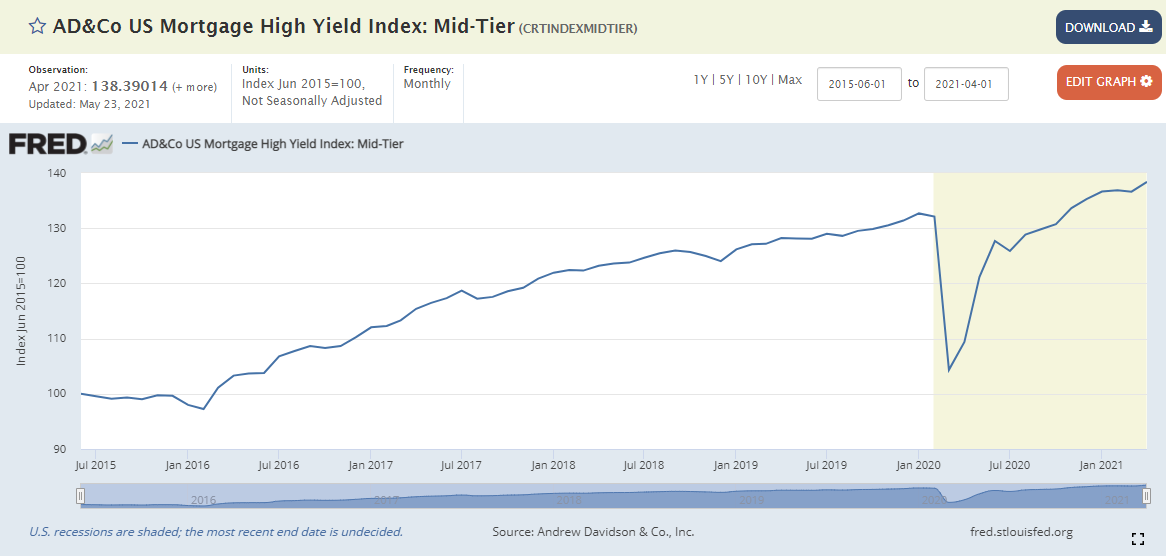
For several years, AD&Co has tracked the total rate of return (TRR) performance of the GSE CAS and STACR CRT in its U.S. Mortgage High-Yield Indices. The AD&Co Mid-Tier index constitutes a broad market measure of the TRR performance of GSE CRT. The related sub-indices segregate the CRT market into 4 index Tiers by attachment point, reflective of the credit exposure of the various classes of underlying CRT ranging from B to M1.
We are pleased to announce that the historical time series for these indices is now publicly available on the St. Louis Federal Reserve's FRED database, along with the credit-adjusted OAS (CrOAS) for each series. FRED is host to almost 800,000 data series from more than 100 sources. The indices published on FRED can be viewed here. Detailed performance analysis related to the index is available on a monthly basis at through AD&Co.
For more information please contact Rob Landauer at 212-274-9075, email Rob at rob@ad-co.com or visit www.ad-co.com.
Disclaimer: The AD&Co U.S. Mortgage High-Yield Index serves as an informational index and is not for commercial-use purposes. The Index’s accuracy, completeness, timeliness, and suitability for any purpose are not guaranteed. The Index does not constitute (1) investment, legal, accounting, tax, or other professional advice or (2) any recommendation or solicitation to purchase, hold, sell, or otherwise deal in any investment. This Index has been prepared for general informational purposes, without consideration of the circumstances or objectives of any particular investor. Any reliance on the Index is at the reader’s sole risk. All investment is subject to numerous risks, known and unknown. Past performance is no guarantee of future results. For investment advice, seek a qualified investment professional. Not for redistribution without permission. Note: An affiliate of Andrew Davidson & Co., Inc. engages in trading activities in investments that may be the same or similar to those featured in the Index.
-
Asian Pacific Heritage MonthEvents

We at Andrew Davidson & Co., Inc. (AD&Co) stand in solidarity with the Asian community and speak out against the xenophobic ignorance that has led to increased racist attacks against Asians. We protest against these hate crimes. This is a time to celebrate the richness that we have gained from the diversity of the Asian culture. We pledge to support the heritage that is part of what makes us American.
-
Mental Health Awareness MonthEvents
What does it mean to be mentally healthy? The answer is different for everyone. With all the extra anxiety that many of us have experienced since 2020, whether from uncertainty about COVID-19 or from other experiences that may be new to us, it’s important to acknowledge that it’s alright to not feel alright. Fortunately, there are numerous resources that are available locally, nationally, and in some cases through your workplace or benefits package. We might start by finding out what makes us feel better. For some, it is a brisk walk outside, a yoga class, talking to a friend, or finding a sympathetic therapist. The possibilities are endless. Let’s take this month to think about what WE need.
-
Introducing AutoLDM—A New Way to Analyze Auto LoansProducts
Today marks the publication of Chris Widman's Quantitative Perspective, a comprehensive article on the newest member of our LoanDynamics suite, the Auto LoanDynamics Model. Auto LDM will be integrated into vendor systems and AD&Co tools, allowing users to perform analysis on auto loan and ABS positions. Applications include economic scenario analysis to examine the impact of unemployment scenarios or rates on defaults, losses and prepayments, stress testing for CCAR/CECL, valuation and risk measurement.
The article provides an overview of the auto loan market, discusses the underlying data used for estimation, our model architecture, and contains sections on delinquency, seasonality, unemployment and severity determinants. We look forward to your feedback – please reach out to us at support@ad-co.com if you are interested in more details or a trial.
-Eknath Belbase
-
The Earth is Our Home: Let's Not Default on itEvents

Since 1970, April 22nd has been the annual day to appreciate our planet and recognize the importance of protecting it. But more and more, we realize that everyday needs to be Earth Day, and that we need to take better care of the place that gives us life. It’s becoming harder and harder to doubt the legitimacy of climate change, and how we as humans contribute it. At Andrew Davidson & Co., Inc. (AD&Co) we recognize the dramatic nature of climate change and how it effects our neighbors around the world. As experts in the mortgage market, we’re looking at the ways extreme weather, such as hurricanes, floods, drought, and melting glaciers, affects people’s homes, their way of life—and the availability and price of housing.
In our December 2020 Pipeline article we anticipated an increasing expectation on the need to measure and disclose exposure to climate change, and laid out some of the analytic challenges. We have focused on studying the existing research, reaching out to climate risk research firms, and understanding the landscape of what is available and what needs to be developed. As we explore different product ideas, we expect to reach out to our existing clients to help us understand better the ways we can continue to deliver leading-edge analytics in this space.
For additional information, check out this panel featuring AD&Co’s Eknath Belbase.
The S-Curve Archives
-
 Thoughts
For many people, having accessible transportation (a car, for example) is necessary. Most U.S. people live in areas without adequate public transportation and require vehicles to access jobs, healthcare, and groceries.
-
Thoughts
As interest rates rise and fewer loans with refinancing incentive remain, other factors are primed to play a larger role in determining prepayment speeds in the coming months (and perhaps years). Turnover, the rate at which people move, is the most cited of these factors. In this blog post, we’ll consider two other potential drivers: curtailments, or partial prepayments, and mortgage payoffs that don’t involve taking out a new loan.
-
Thoughts
Summary
In 2021, Andrew Davidson & Co. Inc. (AD&Co) proposed a benchmark cohort approach to setting Ability-to-Repay (ATR) Qualified Mortgages (QM) standards. Successful benchmarks based on data are model-free and transparent, and the cohorts must perform consistently in comparison to one another and across time. Our original work used data through the early stages of the pandemic when non-performing loan percentages skyrocketed.
-
 Thoughts
How Lowering Capital Costs Affects Higher-Risk Loans
Government-sponsored enterprises (or GSEs) are companies that provide guarantees and financing to originators through the mortgage secondary market. The size and resilience of the GSE secondary market maximizes diversification and liquidity which reduces financial risk and cost of capital. This benefit accrues to conforming borrowers through lower mortgage rates and resiliently available financing.
-
 Products
The release of Andrew Davidson & Co., Inc.’s (AD&Co) new generation of financial engineering tools marks a shift to a new reality; when the traditional benchmark for MBS valuation, the LIBOR/ Swap yield curve, becomes unavailable. Our recent Product Release email informed our readers about the change. In short, our users can:
-
 Thoughts
FHFA held a listening session for interested parties on its proposed rule on the GSE process for credit scores. The objective is making mortgage underwriting and pricing more accurate and more fair while balancing practical implementation by firms in the mortgage ecosystem. Along with many others, I had the opportunity to provide insights on this proposed rulemaking.
-
 Thoughts
In our January 19th blog entitled, A More Equitable Lending System Will Not Be Created by Accident, we described the efforts it will take to overcome not just bias in lending today, but the systemic factors that have limited access to credit in the past and have created an unjust system.
-
 Thoughts
In this short blog post I discuss some developments taking place in the flood insurance landscape in the US and look ahead at a few potential directions things could go. I suggest that universal catastrophic flood insurance coverage with a continuation of the introduction of risk-based pricing would be a significant improvement.
-
 Thoughts
Introduction
The Government-Sponsored Enterprises (GSEs) entered conservatorship in September 2008. One could view the succeeding thirteen years as a journey back to financial stability with a refined operating model that looks more like a financial utility than a hedge fund. This business model is more compatible with a fair lending mission for a standard-setter that maintains secondary markets under an effective regulator. The GSEs remain the largest part of the housing finance backbone and a resilient funding source during economic stress.
-
Thoughts
Around 75% of white American families were homeowners in the first quarter of 2020, according to data from the United States Census Bureau. However, only 44% of Black American families owned their homes at the same time.