

Welcome to The S-Curve
Now you will be able to receive the latest announcements, product updates, and our insights on the mortgage market in real time.
The name of the blog, the S-Curve, is a reflection of our logo and the central feature of our prepayment model. S-curves are seen in nature in many phenomenon, from population growth to prepayment and default models. Our first S-curve, in the early 1990s, used the arctangent function, then piece-wise linear functions, and evolved over time to be more complex and vary by FICO, loan size and LTV. This evolution encapsulates both the timeless nature of fundamental relationships and constant innovation to describe them better over time.
We hope you find the information useful and we look forward to your feedback.
-
 Mortgage Origination in a Post-COVID-19 WorldThoughts
In this blog post, we used the recently updated Mortgage Market Statistical Annual to examine the dynamics of residential loan origination by state and by market segments and highlight important trends.
From mid-2020 until April 2022, the Fed Funds rate was zero and fixed rate mortgage rates were historically low at about 3% (see Figure 1). Thereafter, the Fed began raising the Fed Funds rate to 5% today and fixed rate mortgage rates have doubled. Mortgage payments became unaffordable to many potential buyers and the mortgage origination volume dropped drastically across market segments and states by 80%. Predictably, the refinance market disappeared. Figure 2 shows that the origination volume for different mortgage products decreased drastically from Q1 2021 to 2023.
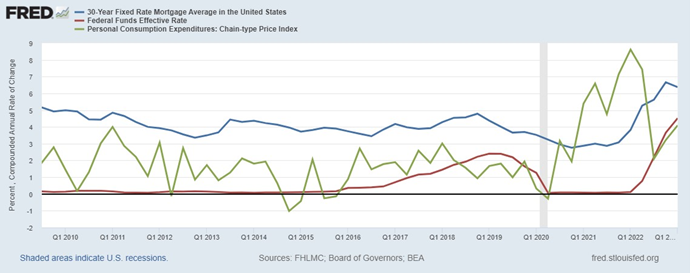
Figure 1. 30-Year Mortgage Rate, Fed Funds Effective Rate and PCE Price Index
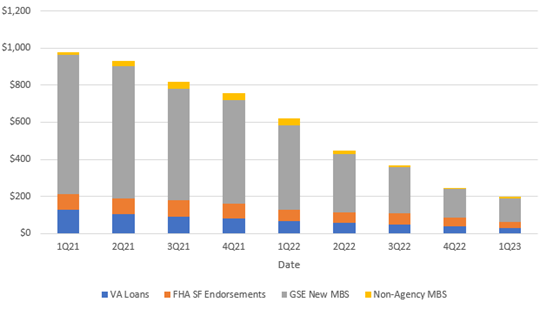
Figure 2. Origination Volume by Market Composition (Dollars in Billions)
Homeowners with low-rate mortgages have a strong financial incentive not to sell when facing the prospect of buying a new house with a mortgage rate twice as high (lock-in effect). These homeowners on the sidelines reduce both the supply and demand for housing. The countervailing impacts on price make the ultimate effect unclear; prices could rise or fall, but the changes are likely to moderate.
Figure 3 shows two things; (1) the housing price spike during the pandemic when rates were so low and the predicted recent collapse when rates rose and (2) turning points in housing prices lead to turning points in new construction rates weighted by population.
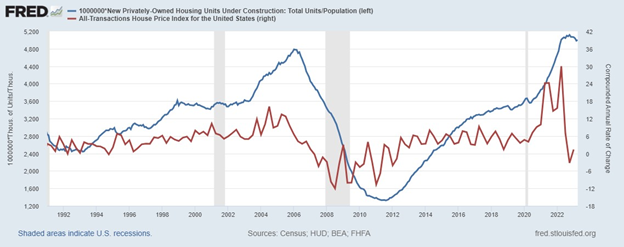
Figure 3. Housing Units Under Construction vs HPI
Looking at the States
Across the 50 states, plus Washington D.C. and Puerto Rico, origination dropped 48% from 2021 to 2022. For some background, YoY changes for the past few months have been positive, with 2019 to 2020 year-over-year (YoY) showing a 78% increase. We have to go back to 2016 to 2017 to see a negative 10% YoY drop and 2017 to 2018 a negative 9% drop. Among the most populous states, California suffered the largest drop YoY, declining by a whopping 60%. Some other states with a big YoY drop in origination include Maryland, 55%, Virginia, 54% and Massachusetts, 53%. On the other end, Texas and Florida had the smallest YoY losses at around 33%.
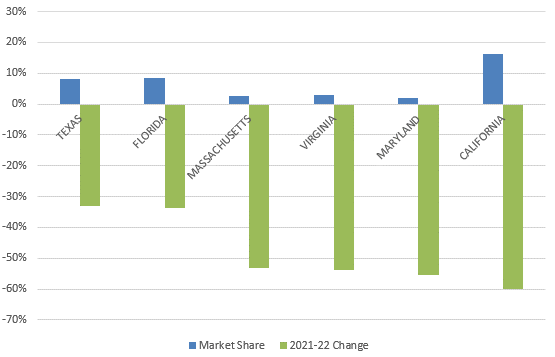
Figure 4 Originations by State
The situation in California, the most expensive state with the most expensive housing market was obvious; the escalating rate hikes priced many potential buyers out of the housing market in a state already hurt by the high income and property taxes.
The situations in Florida and Texas were drastically different. As low tax states, they represented good buying options even in a severe market turn and suffered the least drops.
Naturally, people are motivated to move to more tax-friendly states such as Florida when they retire. As the global pandemic hit and changed how people live and work, it further amplified that migration trend. Workers who once needed to live in states with hot employment markets like California’s tech hub can now work remotely and leave for other lower-cost states.
From Refinance to Purchase
The ten consecutive Fed rate hikes eliminated the refinance boom and deterred existing borrowers from moving, a combination leading to the plunge of origination. The refinance share has fallen from 71% in Q1 2021 to 16% in Q4 2022. On the turnover side, purchasing activities are still ongoing amidst the high rate environment. Purchase volume is not as drastically changed but still has fallen 13% from 2021. Figure 3 still shows a very steady volume of purchase originations over the past two years, despite its obvious decline over the past months. The decrease of the purchase volume can be attributed to the “lock in effect.”[1] The lock in effect is visible for discount mortgages as it deters potential sellers from giving up their current low-rate loan and finance next property with a more expensive one even if they have plans to relocate.
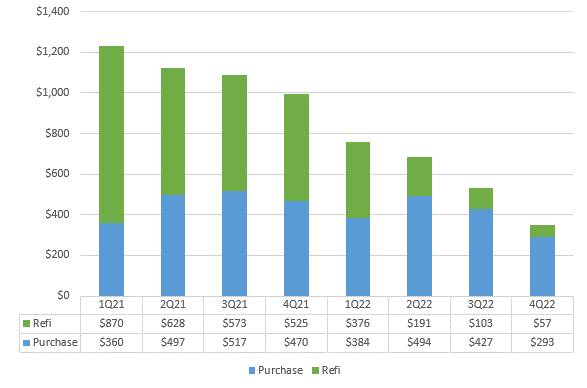
Figure 5. Purchase vs Refi Origination Volume (Dollars in Billions)
Looking Forward
We will continue to monitor changes in origination trends and their connection with affordability and home prices in our borrower behavior and home price modeling. For additional insight, read AD&Co’s HPI Outlook Update by Alex Levin.[2]
[1] Baker, Joni, and Daniel Swanson. “How to Use AD&Co’s Deep Discount and Super Premium S-Curve Tuning.” Quantitative Perspectives (May 2023).
[2] Levin, Alex. “AD&Co’S HPI Outlook Update: Flat, But Multidirectional.” The Pipeline, no. 182 (June 2023).
The S-Curve Archives
-
 Thoughts
We’re excited to announce our latest Quantitative Perspectives providing in-depth insights into current market trends and advanced valuation techniques. This publication offers valuable information for mortgage market participants and those involved in credit risk transfer transactions.
-
 Podcast
Tune in to Laura Silberg's interview with Andrew Davidson, Eknath Belbase and Alex Levin as they discuss their latest Quantitative Perspectives, our independent commentary series, titled
-
 Thoughts
As providers of mortgage models for financial institutions, Andrew Davidson & Co., Inc. (AD&Co) enables clients to validate their use of our models and offers documentation describing the conceptual framework of the models, back-testing results, and sample forecasts under a variety of economic conditions. We also work with analytics providers who have incorporated our models to ensure that the models works as intended.
-
 Thoughts
We’re excited to announce two new Quantitative Perspectives that provide in-depth insights into current market trends and advanced valuation techniques. These papers offer valuable information for mortgage market participants and those involved in credit risk transfer transactions.
-
 Events
Andrew Davidson & Co. Inc. (AD&Co) proudly sponsored the Information Management Network (IMN)’s 10th Annual Mortgage Servicing Rights (MSR) Forum, held November 21 - 22, 2024 at the New York Marriott at Brooklyn Bridge.
-
Podcast
Tune in to Michelle Stepien Breier's interview with Alex Levin & Matteo Caracciolo-King as they discuss their latest Pipeline article “AD&Co Updates its Home Price Index Model.” The interview highlights key points from the article as they share recent updates to the HPI3 model.
-
 Thoughts
With the increasing volumes of Synthetic Risk Transfer (SRT) and Credit Risk Transfer (CRT) along with the discussion of BASEL III, we thought it would be useful to re-issue our comment letter to FHFA on the capital treatment of Credit Risk Transfer.
-
 Podcast
Recently, senior credit modeler, Daniel Swanson had the pleasure of speaking with Rob Kessel from the Panoramic Capital Academy podcast titled, “Modeler’s Perspective on Prepayment Modeling.” T
-
 Thoughts
The earliest paper we found examining the impact of climate risks on house prices was from 2017, which found a relationship between elevation/sea level rise and house price differences.[1]
We built our climate-conditioned HPA model in 2022 based on the idea that an increase in insurance costs would impact house prices (something we had not studied yet) in the same way that an increase of the same size in mortgage rates would impact house prices (something that we were quite familiar with).
-
 News
NewsAndrew Davidson & Co., Inc (AD&Co) is pleased to announce a new alliance with Mortgage Capital Trading, Inc. (MCT), a leading provider of mortgage capital market solutions.