

Welcome to The S-Curve
Now you will be able to receive the latest announcements, product updates, and our insights on the mortgage market in real time.
The name of the blog, the S-Curve, is a reflection of our logo and the central feature of our prepayment model. S-curves are seen in nature in many phenomenon, from population growth to prepayment and default models. Our first S-curve, in the early 1990s, used the arctangent function, then piece-wise linear functions, and evolved over time to be more complex and vary by FICO, loan size and LTV. This evolution encapsulates both the timeless nature of fundamental relationships and constant innovation to describe them better over time.
We hope you find the information useful and we look forward to your feedback.
-
 Takeaways from Lessons Learned: Insights for Managing the Interest Rate Risk of BanksEvents
Andrew Davidson & Co., Inc. (AD&Co) held a webinar on June 8th entitled “Lessons Learned: Insights for Managing the Interest Rate Risk of Banks.” Mickey Storms from our Alliances and Policies team, Alex Levin from our Financial Engineering team and Andrew Davidson were featured speakers.
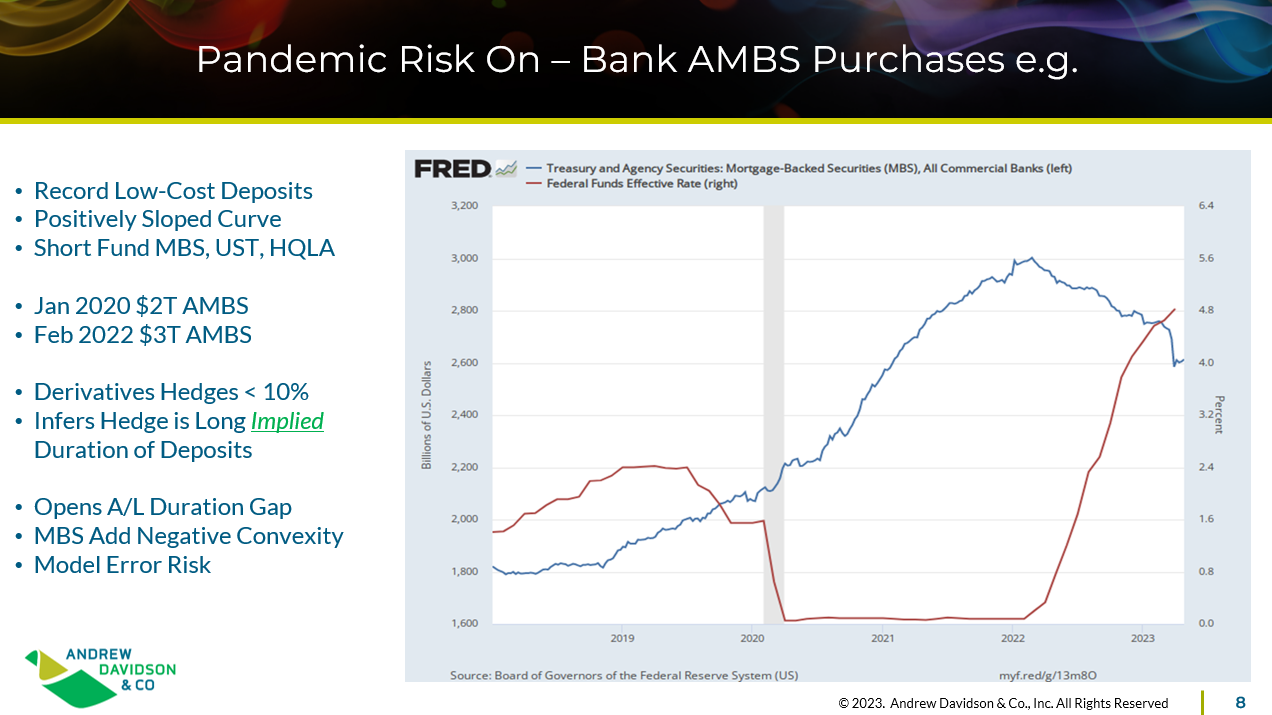
Mickey revisited interest rate changes since the onset of the pandemic and showed how these led to changes in appetite for yield curve risk at banks as interest rate declines compressed their Net Interest Margins (NIM) as depicted in the slid below. He went on to show how this appetite conveyed a questionable sense of comfort by banks that the Assets and Liabilities (A/L) duration gap would not be problematic in the future. The example presented was the strategy of increased short funding of MBS with deposits as rates fell during the pandemic, the success of which depended on an implied long duration of deposits to conceive of a manageable duration gap between A/L. He went on to show the significant duration that exists on the asset side of bank balance sheets and that in the absence of hedging, the success of short funding strategies relies critically on the behavior and duration of deposits whose behavior has changed recently. Mickey closed by pointing out that there has been a lack of regulatory focus on Interest Rate Risk (IRR) in recent years that accommodated banks taking interest rate and duration risk at U.S. Banks.
Alex considered several important methodological challenges in measuring IRR and the A/L duration gap. He began with the asset side and explained why an empirically developed prepayment model is not sufficient to fully capture AFS assets’ market sensitivities. For the purpose of replicating those sensitivities, a prepayment model needs to be “risk-neutralized” with faster refinancing and slower housing turnover – the main feared directions of the prepay-model risks. A risk-neutral model would better track market sensitivities of premium and discount assets, as illustrated by the dynamics of different duration measures during 2022 (a similar pattern observed across the TBA coupon stack).
As a risk-neutral turnover rate is slower than an actually observed one, the currently outstanding MBS portfolios (and most banks’ assets) are longer (duration-wise) than many people think.
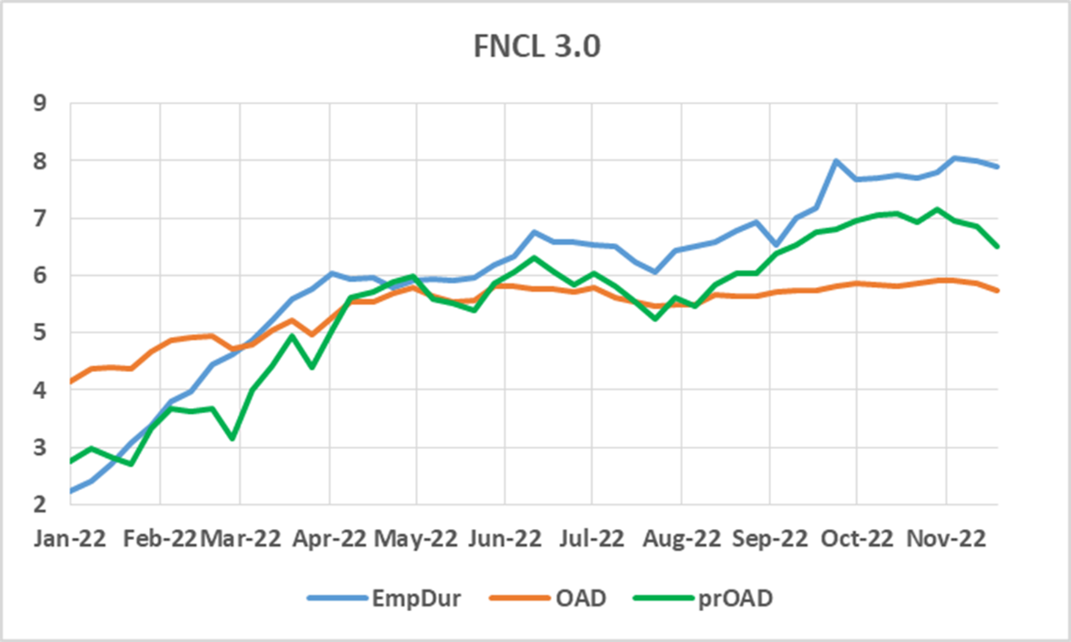
Comparative Duration Measures
OAD – Option-adjusted duration utilizing empirically developed prepay model
prOAD – Option-adjusted duration utilizing risk-neutralized prepay model
EmpDur – Empirical 60-day sensitivity measured from the daily moves of TBA price and 10-yr rate (model-free)Alex discussed the role of Non-Maturing Deposits (NMD). While an empirically defensible model of retention and paid rate is a good start, many external factors are typically not evident from historical data. Those include possible changes in the deposit base or media/bad press effects that could shorten the duration of NMDs. Therefore, A/L duration gaps are likely to be wider than ones measured.
Alex demonstrated a Net Present Value (NPV) analysis of a hypothetical bank with assets, term liabilities, and NMDs. He constructed a TBA-13-type of NPV of equity profile for two cases:
- NMDs are intact (chart on the left below)
- NMDs are replaced with par-valued liabilities having no intangible value to the bank (chart on the right below).
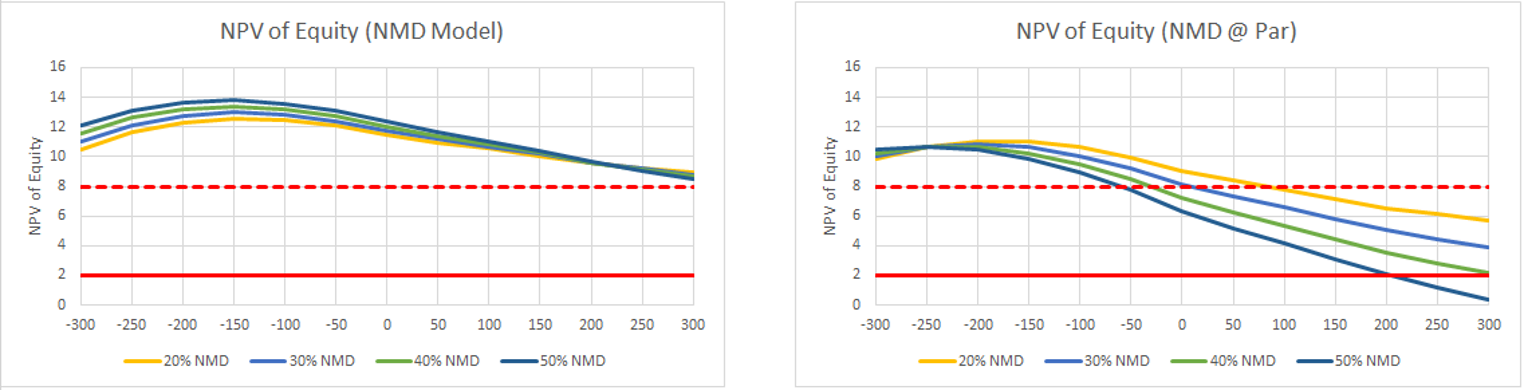
This exclusion of the economic value of NMDs from the NPV consideration is a useful stress-test we recommend banks conduct.
A bank’s hesitation to hedge IRR is commonly linked to a loss of NIM under the commonly steep yield curve. Under the current inversion, swaps have a positive carry that would improve NIM while closing (or even inverting) the duration gap. Alex demonstrated the use of a 3-year SOFR swap that would make the same bank duration-neutral while adding 50 bps of NIM or even inverting the IRR exposure while adding 100 bps of NIM.
Andy closed by dimensioning the two-way risks that exist with respect to future interest rates and the shape of the yield curve and pointed out how this may impact the dynamics of other assets and businesses that banks maintain. Among these were mortgage servicing and origination. He addressed bank risk management board roles, policies, procedures and controls and discussed the critical importance of an open culture with respect to risk insights and tactics. The review of models and scenarios used to manage IRR was also presented, as was the importance of asset diversification and capital allocation processes that include risk limits. He closed by talking about Basel 2 IRR analytical methods and how focusing on economic value, earnings and market are essential to effective IRR management.
Click here to view the presentation and webinar recording.
The S-Curve Archives
-
 Thoughts
Recently, aggregators have crossed market borders by issuing residential mortgage-backed securities (RMBS) backed by owner-occupied (OO), GSE-eligible conforming loans. Additionally, conforming mortgage loans have drawn investment interest from insurance companies fronted by aggregators and evaluated by third-party firms. These developments constitute historically rare disintermediations of the nearly monopsonist purchases of conforming loans by the GSEs.
-
 Podcast
Join Rob Landauer in a conversation with Abe Martin as they discuss his recent Pipeline article, "Modeling the Balance Behavior of HELOC Borrowers." In this episode, they highlight key points from the article as he shares insights into the draw component of HELOCs and provide an update on the beta rele
-
News
We’re excited to announce a major addition to the Andrew Davidson & Co., Inc. (AD&Co) team. Industry leaders Kelli Sayres and Gene Park, known for building and scaling leading fixed-income analytics platforms, have joined AD&Co’s Business Development team.
-
 Thoughts
Building on our earlier research on expanded consumer attributes, AD&Co continues to explore how credit data contributes to modeling delinquency and prepayment risk, which are key drivers of mortgage servicing rights cash flows and valuation.
-
 Events
Andrew Davidson recently joined NFM Lending’s Greg Sher on the One On One podcast to discuss our recent white paper, “The Impact of Moving Away From the Tri-Merge Standard.”
-
 Events
AD&Co recently sponsored and attended SFVegas 2026 and Optimal Blue Summit 2026. This post shares the AD&Co team's unique perspectives and key takeaways from attending both conferences.
-
 News
NewsAD&Co US Mortgage High Yield Indices
The Federal Reserve Economic Data (FRED) portal, housed by the Federal Reserve Bank of St. Louis, has been publishing AD&Co’s CRT indices since 2019. These series posted under the overall name of “US Mortgage High-Yield” include total return rates and credit and option-adjusted spreads (crOAS) – a projected return’s spread over Treasury (in the past, Libor). These series are available going back to 2014-end and tiered by CRT initial supports.
-
 Thoughts
In July 2025, the US Federal Housing Finance Agency (FHFA) announced that the government-sponsored entities (the Enterprises or GSEs), Fannie Mae and Freddie Mac, would permit lenders to choose between Classic FICO and VantageScore 4.0 credit score models for loans sold to the GSEs. FHFA also stated in a social media post that the tri-merge standard would be maintained for mortgage underwriting. Nevertheless, some mortgage industry stakeholders recommend moving away from the tri-merge standard for GSE mortgages in favor of a single or bi-merge report standard.
-
News
As housing faces more climate threats that result in more losses, the insurance program that it sits on is teetering on the brink of collapse. Yet, the home insurance market has three distinct stakeholders that have competing priorities, and today, there is no motivation for a collaborative solution.
Understanding how to strengthen and protect the current structure requires looking at the cost burdens along with the risk for each of those parties.
-
 Thoughts
There has been a flurry of activity in the mortgage markets since the 2018 passage of the Economic Growth, Regulatory Relief, and Consumer Protection Act. This act requires the Federal Housing Finance Agency (FHFA, now known as US Federal Housing) to validate and modernize the credit score models used in the housing finance system. It should be noted that so far, the discourse has been around mortgages sold to the Enterprises (Fannie Mae and Freddie Mac). Ginnie Mae has not provided any guidance on their plans to start using new credit score models.