

Welcome to The S-Curve
Now you will be able to receive the latest announcements, product updates, and our insights on the mortgage market in real time.
The name of the blog, the S-Curve, is a reflection of our logo and the central feature of our prepayment model. S-curves are seen in nature in many phenomenon, from population growth to prepayment and default models. Our first S-curve, in the early 1990s, used the arctangent function, then piece-wise linear functions, and evolved over time to be more complex and vary by FICO, loan size and LTV. This evolution encapsulates both the timeless nature of fundamental relationships and constant innovation to describe them better over time.
We hope you find the information useful and we look forward to your feedback.
-
 Takeaways from Lessons Learned: Insights for Managing the Interest Rate Risk of BanksEvents
Andrew Davidson & Co., Inc. (AD&Co) held a webinar on June 8th entitled “Lessons Learned: Insights for Managing the Interest Rate Risk of Banks.” Mickey Storms from our Alliances and Policies team, Alex Levin from our Financial Engineering team and Andrew Davidson were featured speakers.
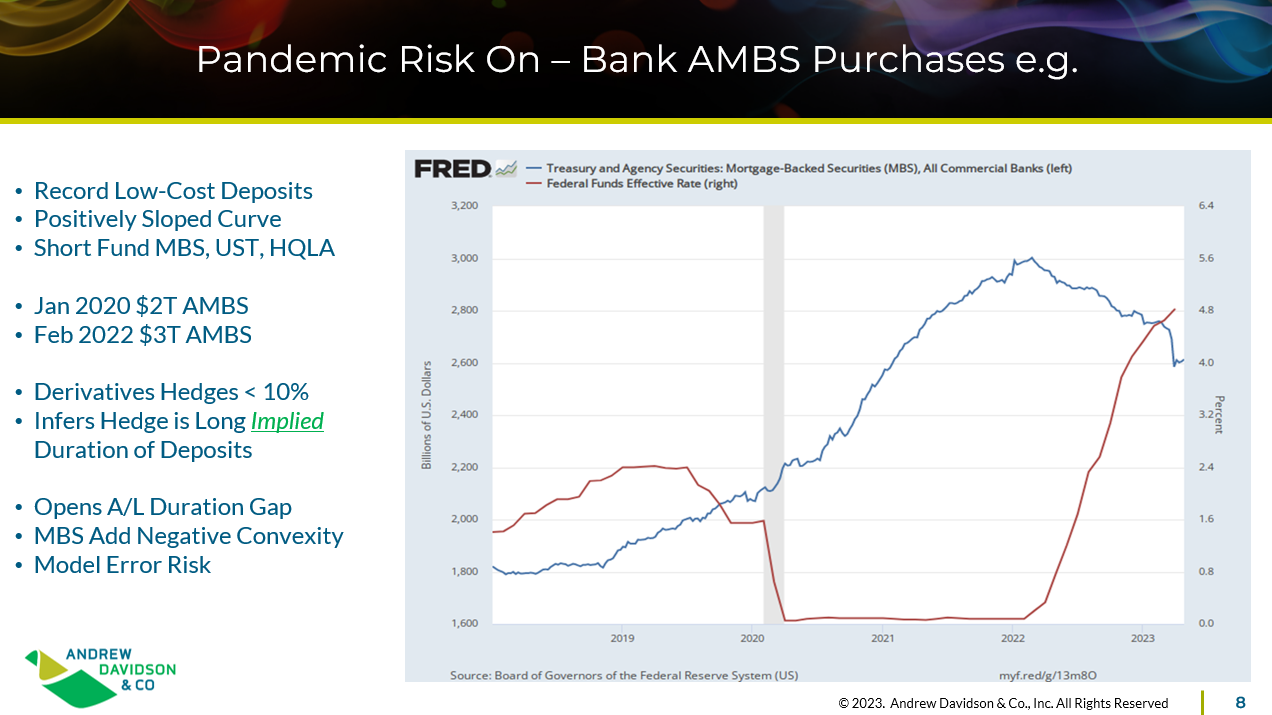
Mickey revisited interest rate changes since the onset of the pandemic and showed how these led to changes in appetite for yield curve risk at banks as interest rate declines compressed their Net Interest Margins (NIM) as depicted in the slid below. He went on to show how this appetite conveyed a questionable sense of comfort by banks that the Assets and Liabilities (A/L) duration gap would not be problematic in the future. The example presented was the strategy of increased short funding of MBS with deposits as rates fell during the pandemic, the success of which depended on an implied long duration of deposits to conceive of a manageable duration gap between A/L. He went on to show the significant duration that exists on the asset side of bank balance sheets and that in the absence of hedging, the success of short funding strategies relies critically on the behavior and duration of deposits whose behavior has changed recently. Mickey closed by pointing out that there has been a lack of regulatory focus on Interest Rate Risk (IRR) in recent years that accommodated banks taking interest rate and duration risk at U.S. Banks.
Alex considered several important methodological challenges in measuring IRR and the A/L duration gap. He began with the asset side and explained why an empirically developed prepayment model is not sufficient to fully capture AFS assets’ market sensitivities. For the purpose of replicating those sensitivities, a prepayment model needs to be “risk-neutralized” with faster refinancing and slower housing turnover – the main feared directions of the prepay-model risks. A risk-neutral model would better track market sensitivities of premium and discount assets, as illustrated by the dynamics of different duration measures during 2022 (a similar pattern observed across the TBA coupon stack).
As a risk-neutral turnover rate is slower than an actually observed one, the currently outstanding MBS portfolios (and most banks’ assets) are longer (duration-wise) than many people think.
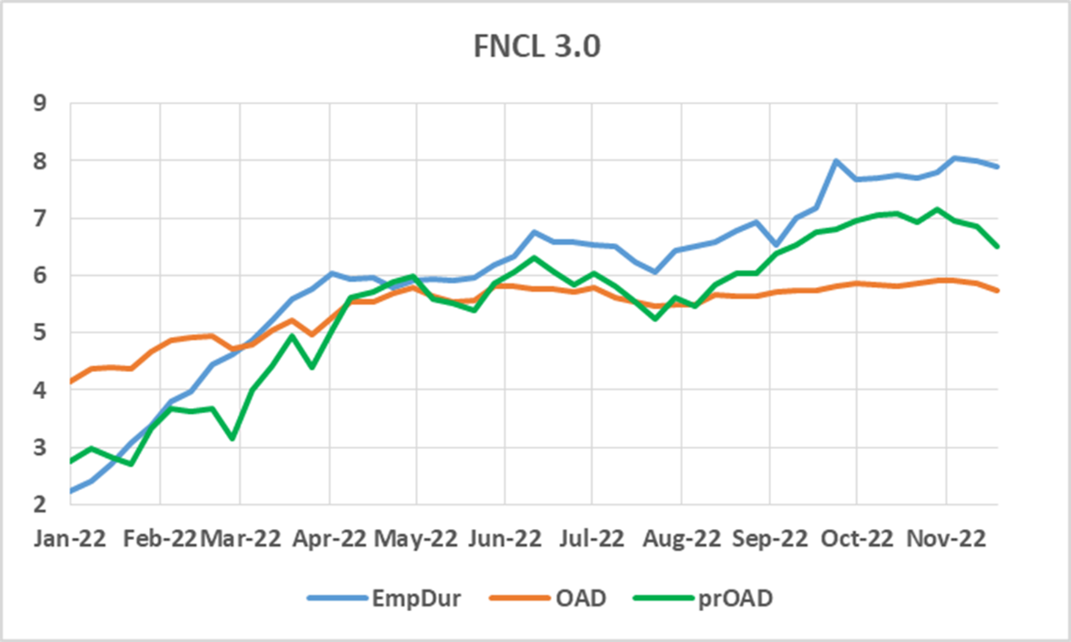
Comparative Duration Measures
OAD – Option-adjusted duration utilizing empirically developed prepay model
prOAD – Option-adjusted duration utilizing risk-neutralized prepay model
EmpDur – Empirical 60-day sensitivity measured from the daily moves of TBA price and 10-yr rate (model-free)Alex discussed the role of Non-Maturing Deposits (NMD). While an empirically defensible model of retention and paid rate is a good start, many external factors are typically not evident from historical data. Those include possible changes in the deposit base or media/bad press effects that could shorten the duration of NMDs. Therefore, A/L duration gaps are likely to be wider than ones measured.
Alex demonstrated a Net Present Value (NPV) analysis of a hypothetical bank with assets, term liabilities, and NMDs. He constructed a TBA-13-type of NPV of equity profile for two cases:
- NMDs are intact (chart on the left below)
- NMDs are replaced with par-valued liabilities having no intangible value to the bank (chart on the right below).
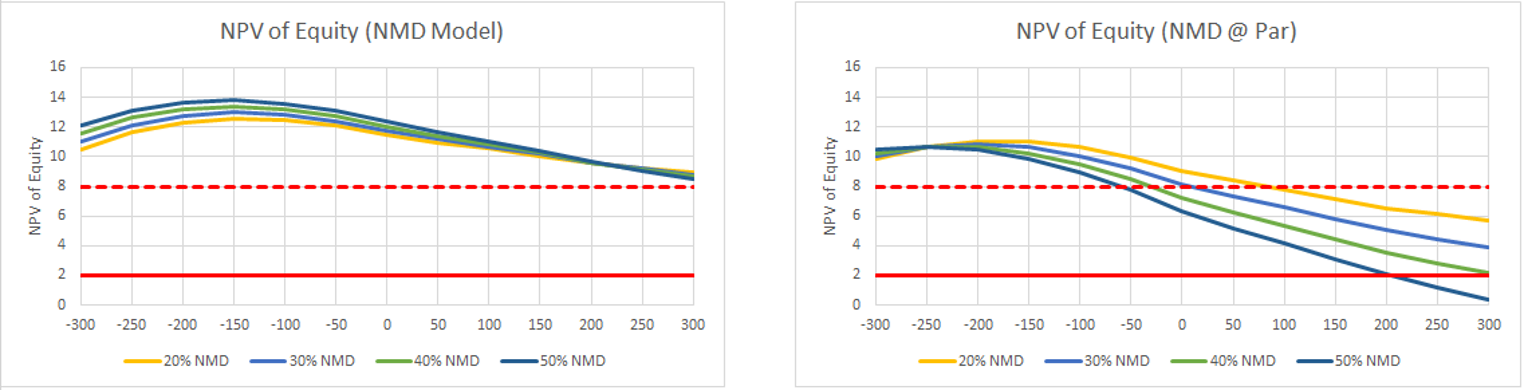
This exclusion of the economic value of NMDs from the NPV consideration is a useful stress-test we recommend banks conduct.
A bank’s hesitation to hedge IRR is commonly linked to a loss of NIM under the commonly steep yield curve. Under the current inversion, swaps have a positive carry that would improve NIM while closing (or even inverting) the duration gap. Alex demonstrated the use of a 3-year SOFR swap that would make the same bank duration-neutral while adding 50 bps of NIM or even inverting the IRR exposure while adding 100 bps of NIM.
Andy closed by dimensioning the two-way risks that exist with respect to future interest rates and the shape of the yield curve and pointed out how this may impact the dynamics of other assets and businesses that banks maintain. Among these were mortgage servicing and origination. He addressed bank risk management board roles, policies, procedures and controls and discussed the critical importance of an open culture with respect to risk insights and tactics. The review of models and scenarios used to manage IRR was also presented, as was the importance of asset diversification and capital allocation processes that include risk limits. He closed by talking about Basel 2 IRR analytical methods and how focusing on economic value, earnings and market are essential to effective IRR management.
Click here to view the presentation and webinar recording.
The S-Curve Archives
-
Thoughts
The growing prevalence of artificial intelligence in the mortgage industry is shining a new light on the human biases that have pervaded the industry since its inception. AI is meant to bring fairness and objectivity to mortgage decisions, but it can’t perform fairly if it was built on an unfair system.
-
Products
The LDM v3.0.2 library adds AutoLDM to the v3.0.1 library.
Key benefits include:
-
EventsWe at Andrew Davidson & Co., Inc. (AD&Co) are once again thrilled to celebrate Pride Month, especially the contributions of LGBTQ professionals in the field of finance including affordable housing policy and the GSEs. This year, in addition to celebrating, we are also paying increased attention to the challenges that LGBTQ individuals face, particularly around issues of housing. Our pride in our LGBTQ staff and community sits alongside our concern about discriminatory lending practices, including in mortgages. As of February 2021, for the first time, lesbian, gay, bisexual, transgender, queer, and questioning (LGBTQ) Americans will be protected from housing discrimination under the Fair Housing Act.
-
News
For several years, AD&Co has tracked the total rate of return (TRR) performance of the GSE CAS and STACR CRT in its U.S. Mortgage High-Yield Indices. The AD&Co Mid-Tier index constitutes a broad market measure of the TRR performance of GSE CRT. The related sub-indices segregate the CRT market into 4 index Tiers by attachment point, reflective of the credit exposure of the various classes of underlying CRT ranging from B to M1.
-
EventsWe at Andrew Davidson & Co., Inc. (AD&Co) stand in solidarity with the Asian community and speak out against the xenophobic ignorance that has led to increased racist attacks against Asians. We protest against these hate crimes. This is a time to celebrate the richness that we have gained from the diversity of the Asian culture. We pledge to support the heritage that is part of what makes us American.
-
Events
What does it mean to be mentally healthy? The answer is different for everyone. With all the extra anxiety that many of us have experienced since 2020, whether from uncertainty about COVID-19 or from other experiences that may be new to us, it’s important to acknowledge that it’s alright to not feel alright. Fortunately, there are numerous resources that are available locally, nationally, and in some cases through your workplace or benefits package. We might start by finding out what makes us feel better.
-
Products
Today marks the publication of Chris Widman's Quantitative Perspective, a comprehensive article on the newest member of our LoanDynamics suite, the Auto LoanDynamics Model. Auto LDM will be integrated into vendor systems and AD&Co tools, allowing users to perform analysis on auto loan and ABS positions.
-
EventsSince 1970, April 22nd has been the annual day to appreciate our planet and recognize the importance of protecting it. But more and more, we realize that everyday needs to be Earth Day, and that we need to take better care of the place that gives us life.
-
Thoughts
To seek "causes" of poverty in this way is to enter an intellectual dead end because poverty has no causes. Only prosperity has causes. – Jane Jacobs, Activist and Author
-
Events
CRTcast, a new podcast series under Freddie Mac’s Home Starts Here programming, focuses on credit risk transfer (CRT) and it’s three spokes: securities, (re)insurance and mortgage insurance. Freddie Mac leadership together with CRT industry experts cover current and relevant topics.