

Welcome to The S-Curve
Now you will be able to receive the latest announcements, product updates, and our insights on the mortgage market in real time.
The name of the blog, the S-Curve, is a reflection of our logo and the central feature of our prepayment model. S-curves are seen in nature in many phenomenon, from population growth to prepayment and default models. Our first S-curve, in the early 1990s, used the arctangent function, then piece-wise linear functions, and evolved over time to be more complex and vary by FICO, loan size and LTV. This evolution encapsulates both the timeless nature of fundamental relationships and constant innovation to describe them better over time.
We hope you find the information useful and we look forward to your feedback.
-
Drivers of Discount PrepaymentsThoughts
As interest rates rise and fewer loans with refinancing incentive remain, other factors are primed to play a larger role in determining prepayment speeds in the coming months (and perhaps years). Turnover, the rate at which people move, is the most cited of these factors. In this blog post, we’ll consider two other potential drivers: curtailments, or partial prepayments, and mortgage payoffs that don’t involve taking out a new loan.
The charts below the rates of curtailment and payoffs in a sample of Fannie Mae loan level data[1].
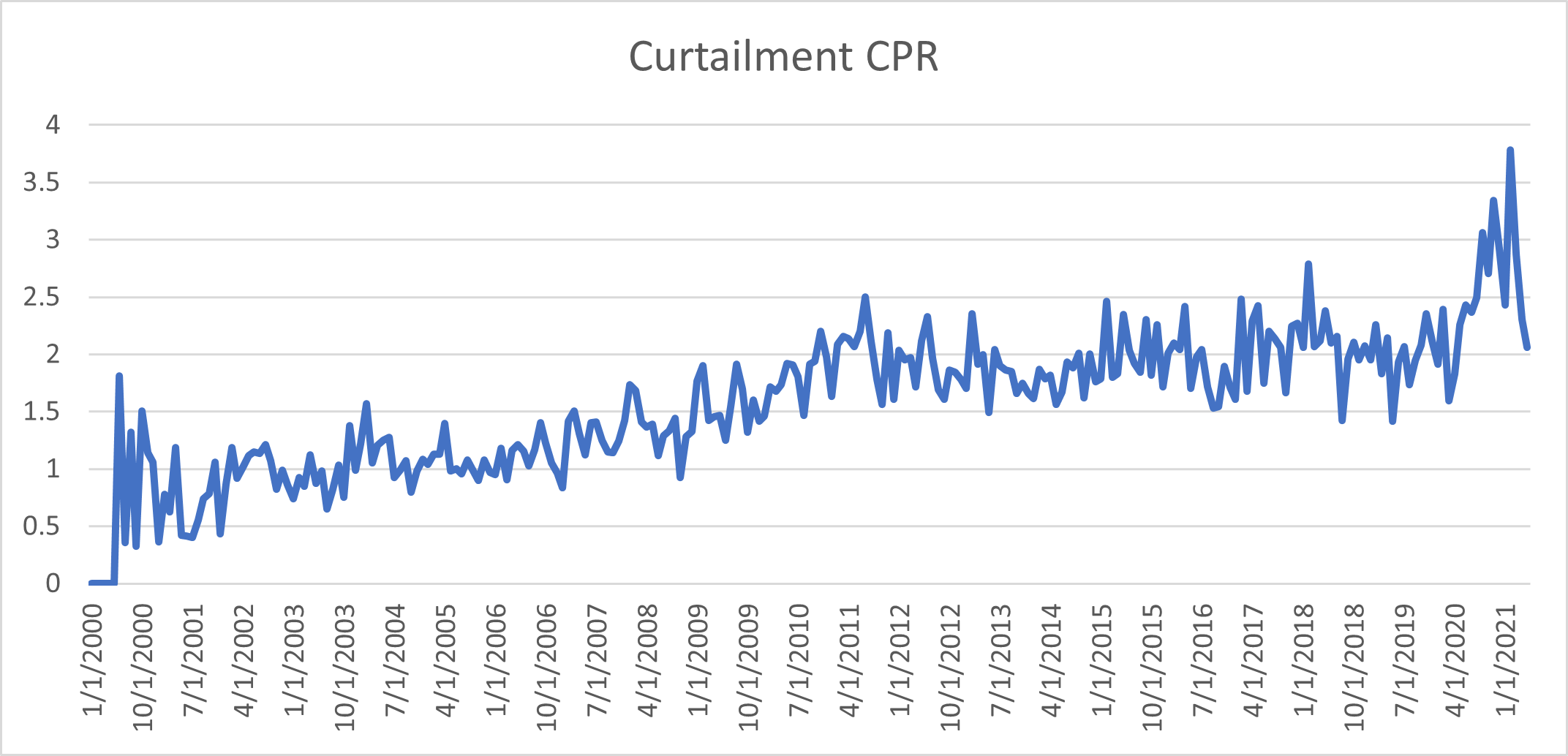
Curtailments involve borrowers making additional payments beyond their amortization schedule yet short of paying off the full amount, i.e., people making an extra payment each month. In the charts we can see the rate rising slightly over time (which is mainly attributed to age; this data only has loans originated after Jan 1999, so the earlier months are limited to younger loans) and settling into a rate around 1.5-2.5 CPR. However, there was also a bit of a jump during the pandemic, which can perhaps be attributed to borrowers having extra cash from stimulus payments.
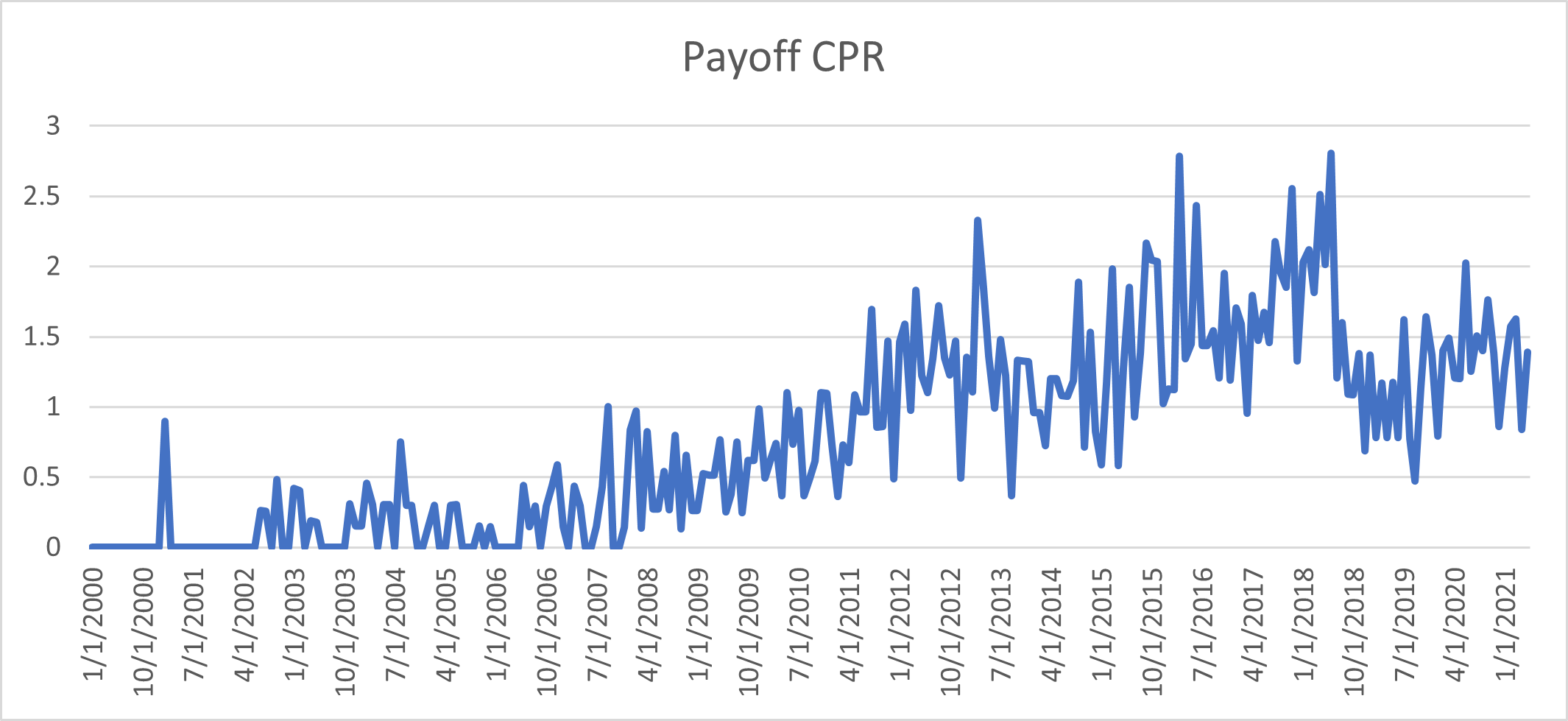
Full payoffs involve paying off a mortgage completely without moving or taking out a new mortgage, which tend to occur if borrowers find themselves with enough cash to cover the outstanding balance. While this can’t be known with 100% certainty, we’ve estimated the rate by looking at payoffs with a remaining term of 36 months of less. These are unlikely to be refinances and while we can’t rule out the possibility of the borrowers moving, we observe payoff rates loans with short remaining terms to be dramatically above the baseline turnover level. In essence, this chart shows the percentage of loans with short remaining terms (low) multiplied by their payoff rate (high) to get the overall contribution to CPR. Like curtailment, the data takes a while to ramp up, but then settles into 1-3 CPR range.
Both series represent a small percentage of prepayments in normal environments, but a greater percentage of the overall level in a world without refinancing. While it’s not a given that these numbers will remain constant in the face of rising rates, it is likely that these factors won’t have quite the same sensitivity to rates as refinancing (this study found payoffs to be relatively flat at negative incentive[1]). If rates stay high, it may be useful to keep these factors in mind moving forward.
[1] https://www.philadelphiafed.org/-/media/frbp/assets/working-papers/2019/wp19-39.pdf
[1] https://capitalmarkets.fanniemae.com/credit-risk-transfer/single-family-credit-risk-transfer/fannie-mae-single-family-loan-performance-data
The S-Curve Archives
-
Thoughts
The growing prevalence of artificial intelligence in the mortgage industry is shining a new light on the human biases that have pervaded the industry since its inception. AI is meant to bring fairness and objectivity to mortgage decisions, but it can’t perform fairly if it was built on an unfair system.
-
Products
The LDM v3.0.2 library adds AutoLDM to the v3.0.1 library.
Key benefits include:
-
EventsWe at Andrew Davidson & Co., Inc. (AD&Co) are once again thrilled to celebrate Pride Month, especially the contributions of LGBTQ professionals in the field of finance including affordable housing policy and the GSEs. This year, in addition to celebrating, we are also paying increased attention to the challenges that LGBTQ individuals face, particularly around issues of housing. Our pride in our LGBTQ staff and community sits alongside our concern about discriminatory lending practices, including in mortgages. As of February 2021, for the first time, lesbian, gay, bisexual, transgender, queer, and questioning (LGBTQ) Americans will be protected from housing discrimination under the Fair Housing Act.
-
News
For several years, AD&Co has tracked the total rate of return (TRR) performance of the GSE CAS and STACR CRT in its U.S. Mortgage High-Yield Indices. The AD&Co Mid-Tier index constitutes a broad market measure of the TRR performance of GSE CRT. The related sub-indices segregate the CRT market into 4 index Tiers by attachment point, reflective of the credit exposure of the various classes of underlying CRT ranging from B to M1.
-
EventsWe at Andrew Davidson & Co., Inc. (AD&Co) stand in solidarity with the Asian community and speak out against the xenophobic ignorance that has led to increased racist attacks against Asians. We protest against these hate crimes. This is a time to celebrate the richness that we have gained from the diversity of the Asian culture. We pledge to support the heritage that is part of what makes us American.
-
Events
What does it mean to be mentally healthy? The answer is different for everyone. With all the extra anxiety that many of us have experienced since 2020, whether from uncertainty about COVID-19 or from other experiences that may be new to us, it’s important to acknowledge that it’s alright to not feel alright. Fortunately, there are numerous resources that are available locally, nationally, and in some cases through your workplace or benefits package. We might start by finding out what makes us feel better.
-
Products
Today marks the publication of Chris Widman's Quantitative Perspective, a comprehensive article on the newest member of our LoanDynamics suite, the Auto LoanDynamics Model. Auto LDM will be integrated into vendor systems and AD&Co tools, allowing users to perform analysis on auto loan and ABS positions.
-
EventsSince 1970, April 22nd has been the annual day to appreciate our planet and recognize the importance of protecting it. But more and more, we realize that everyday needs to be Earth Day, and that we need to take better care of the place that gives us life.
-
Thoughts
To seek "causes" of poverty in this way is to enter an intellectual dead end because poverty has no causes. Only prosperity has causes. – Jane Jacobs, Activist and Author
-
Events
CRTcast, a new podcast series under Freddie Mac’s Home Starts Here programming, focuses on credit risk transfer (CRT) and it’s three spokes: securities, (re)insurance and mortgage insurance. Freddie Mac leadership together with CRT industry experts cover current and relevant topics.