

Welcome to The S-Curve
Now you will be able to receive the latest announcements, product updates, and our insights on the mortgage market in real time.
The name of the blog, the S-Curve, is a reflection of our logo and the central feature of our prepayment model. S-curves are seen in nature in many phenomenon, from population growth to prepayment and default models. Our first S-curve, in the early 1990s, used the arctangent function, then piece-wise linear functions, and evolved over time to be more complex and vary by FICO, loan size and LTV. This evolution encapsulates both the timeless nature of fundamental relationships and constant innovation to describe them better over time.
We hope you find the information useful and we look forward to your feedback.
-
 Leveraging Data and Analytics: Highlights from the IMN MSR Forum 2024Events
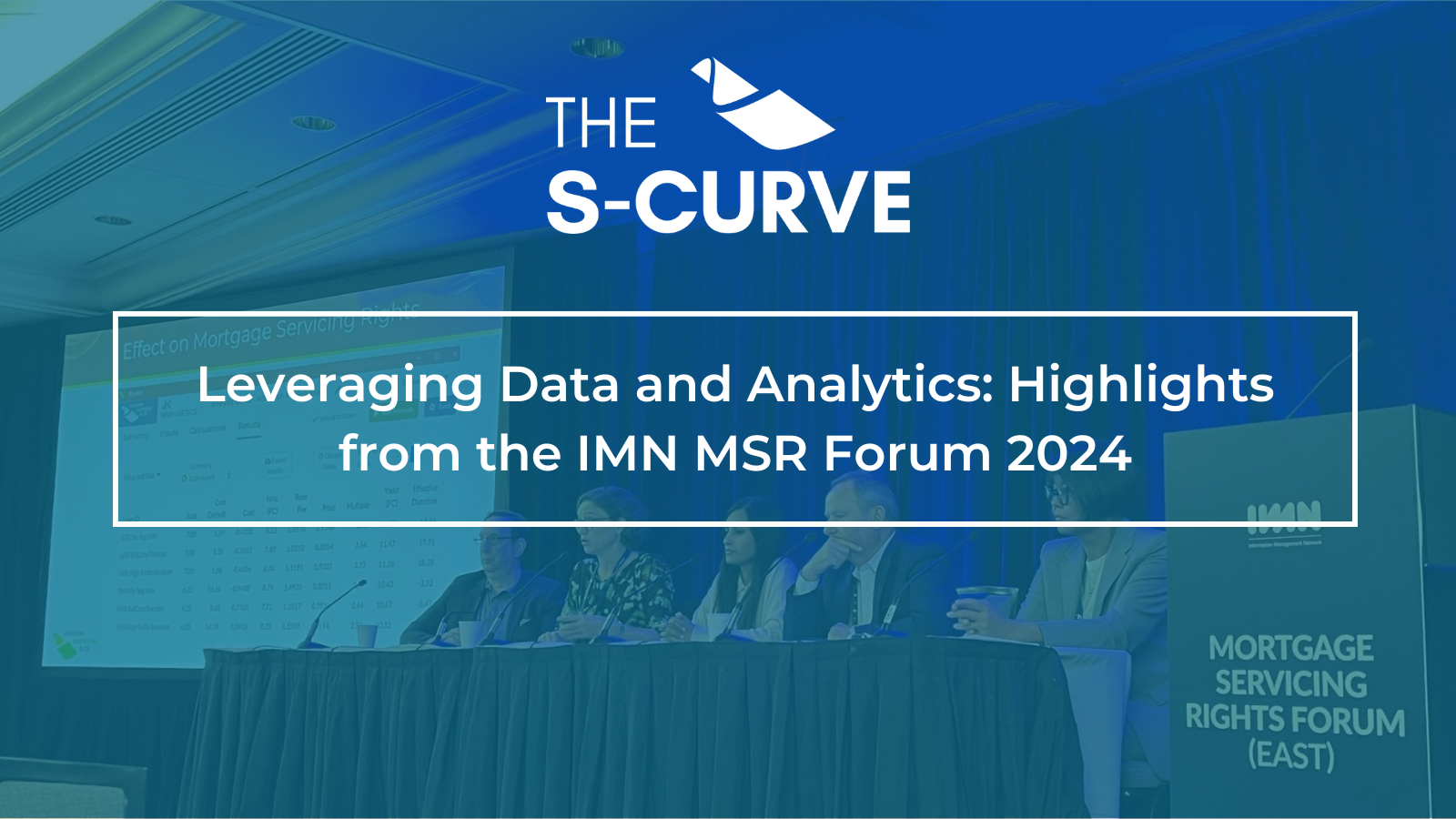
Andrew Davidson & Co. Inc. (AD&Co) proudly sponsored the Information Management Network (IMN)’s 10th Annual Mortgage Servicing Rights (MSR) Forum, held November 21 - 22, 2024 at the New York Marriott at Brooklyn Bridge. Our servicing expert Richard Cooperstein moderated and I spoke on the panel “Leveraging Trended Data to Enhance Your MSR Portfolio’s Mortgage Prepayment and Credit Modeling.” This panel focused on enhanced consumer data, its impact on delinquencies and prepayments (as shown in our white paper), and the process to bring the data and analytics into decision-making.
Other panels at the event discussed a variety of topics, including the interest rate outlook, macroeconomic factors, climate factors, and their effects on prepayments, escrow, originations, delinquencies, new versus seasoned MSRs, MSR supply and demand, and rate hedging strategies and functionality. The panel discussions underscored the need for a deeper understanding and management of the interest rate and credit risks embedded in the federal mortgage servicing asset. Recapture and the importance of good customer service were recurring themes throughout the conference.
Cautious Optimism for the MSR Market
The overall sentiment regarding MSR assets was a cautious optimism: Despite being a complex asset class, the MSR market remains strong, and people want to buy. Many panelists took the view that due to full employment, a strong GDP, and expectations about the economy and a large and increasing deficit, interest rates in 2025 would see at most a modest decrease before rising again. However, this view was not universally shared, with some pointing to a potential economic downturn and increased defaults being hinted at by delinquency trends in auto credit being close to pre-Covid levels, and the subset of Covid forbearance mortgages that will ultimately default.
For borrowers who already have low mortgage rates, there is limited room for modification; it is interesting to note that one servicer mentioned having some mortgages in foreclosure even with low LTV. Meanwhile, some borrowers bought homes in 2023 hoping to ultimately refinance into lower rates, but the opportunity has not arisen (and might not anytime soon). Finally, due to climate factors and inflation, insurance in some areas is becoming increasingly unaffordable or unavailable. In some regions, such as Florida, some condominium owners are facing massive assessments. One servicer noted that with the current high home prices, most consumers facing high insurance increases can sell their homes. However, there is evidence that when insurance premiums rise to the level of 30-40% of principal and interest, delinquencies also begin to rise. AD&Co’s Climate Impact Suite (currently in beta testing) distinguishes between the effect of climate change on home prices (through Climate Conditioned HPA) and the effect of high premiums on borrower behavior (through Climate Conditioned LDM), with the first effect feeding into the second; if the CLTV remains low, high premiums lead to increased turnover, but if the CLTV becomes high, delinquencies increase.
Uncertainty and the Importance of Prepayment Forecasting
In general, and especially with the new administration coming in, uncertainty was a key theme throughout the forum. It was suggested more than once that the economy may have some curve balls. Regardless – and as always – the ability to forecast prepayment speeds is key for valuing MSR’s. Prepayments determine the total base fee collected on a mortgage, as well as the earnings on escrow and payment float, which have become larger and increasingly important components of MSR valuation due to higher interest rates.
For current coupon mortgages, much depends on the interest rate forecast. For low-rate mortgages, however, it's important to understand the economics of turnover (especially when no rate incentive exists) and predict which borrowers are more likely to prepay at a low rate, such as 3%. The overall low prepayment rate among this set could potentially rise due to a pent-up demand to move, especially with more firms pushing for employees to return to the office.
Many panelists spoke about recapture, which was a prominent theme of the conference: recapture refers to the situation in which the servicer retains the borrower by servicing the new loan as well. Some servicers account for recapture in their valuation, and some use models for predicting recapture rates. The necessity of providing excellent customer service arose in multiple panels as essential for increasing recapture and selling ancillary products while also reducing delinquencies and defaults.
"Know Your Data and Your Portfolio"
One panelist observed that, in the current environment, it is now more important than ever for servicers to “know your data and your portfolio”. The topic was addressed during the AD&Co-moderated panel “Leveraging Trended Data to Enhance Your MSR Portfolio’s Mortgage Prepayment and Credit Modeling”. David Doyle of Sagent first discussed some of the challenges in understanding the strengths and risks of potential MSR acquisitions, while Gauhar Turmuhambetova of BlackRock outlined the challenges of using dynamic credit bureau data in the valuation of securitized products. Bindiya Jain of Experian described the granular loan-level insights available on their platform and specifically within their mortgage performance dataset. Then I shared research that illustrates how Experian’s trended data attributes may be used to improve mortgage prepayment and delinquency forecasts beyond what may be inferred from a traditional credit score. I also demonstrated through AD&Co’s MSRKinetics application how these improved forecasts would affect the base fee and cost components of MSR valuation for sample GSE and FHA loans, as well as their weighted average lifetimes and duration profiles.
Overall, IMN’s MSR forum provided a rich opportunity to engage with participants in the MSR industry, learn about their views and needs, and explore potential synergies.
The S-Curve Archives
-
 Thoughts
Recently, aggregators have crossed market borders by issuing residential mortgage-backed securities (RMBS) backed by owner-occupied (OO), GSE-eligible conforming loans. Additionally, conforming mortgage loans have drawn investment interest from insurance companies fronted by aggregators and evaluated by third-party firms. These developments constitute historically rare disintermediations of the nearly monopsonist purchases of conforming loans by the GSEs.
-
 Podcast
Join Rob Landauer in a conversation with Abe Martin as they discuss his recent Pipeline article, "Modeling the Balance Behavior of HELOC Borrowers." In this episode, they highlight key points from the article as he shares insights into the draw component of HELOCs and provide an update on the beta rele
-
News
We’re excited to announce a major addition to the Andrew Davidson & Co., Inc. (AD&Co) team. Industry leaders Kelli Sayres and Gene Park, known for building and scaling leading fixed-income analytics platforms, have joined AD&Co’s Business Development team.
-
 Thoughts
Building on our earlier research on expanded consumer attributes, AD&Co continues to explore how credit data contributes to modeling delinquency and prepayment risk, which are key drivers of mortgage servicing rights cash flows and valuation.
-
 Events
Andrew Davidson recently joined NFM Lending’s Greg Sher on the One On One podcast to discuss our recent white paper, “The Impact of Moving Away From the Tri-Merge Standard.”
-
 Events
AD&Co recently sponsored and attended SFVegas 2026 and Optimal Blue Summit 2026. This post shares the AD&Co team's unique perspectives and key takeaways from attending both conferences.
-
 News
NewsAD&Co US Mortgage High Yield Indices
The Federal Reserve Economic Data (FRED) portal, housed by the Federal Reserve Bank of St. Louis, has been publishing AD&Co’s CRT indices since 2019. These series posted under the overall name of “US Mortgage High-Yield” include total return rates and credit and option-adjusted spreads (crOAS) – a projected return’s spread over Treasury (in the past, Libor). These series are available going back to 2014-end and tiered by CRT initial supports.
-
 Thoughts
In July 2025, the US Federal Housing Finance Agency (FHFA) announced that the government-sponsored entities (the Enterprises or GSEs), Fannie Mae and Freddie Mac, would permit lenders to choose between Classic FICO and VantageScore 4.0 credit score models for loans sold to the GSEs. FHFA also stated in a social media post that the tri-merge standard would be maintained for mortgage underwriting. Nevertheless, some mortgage industry stakeholders recommend moving away from the tri-merge standard for GSE mortgages in favor of a single or bi-merge report standard.
-
News
As housing faces more climate threats that result in more losses, the insurance program that it sits on is teetering on the brink of collapse. Yet, the home insurance market has three distinct stakeholders that have competing priorities, and today, there is no motivation for a collaborative solution.
Understanding how to strengthen and protect the current structure requires looking at the cost burdens along with the risk for each of those parties.
-
 Thoughts
There has been a flurry of activity in the mortgage markets since the 2018 passage of the Economic Growth, Regulatory Relief, and Consumer Protection Act. This act requires the Federal Housing Finance Agency (FHFA, now known as US Federal Housing) to validate and modernize the credit score models used in the housing finance system. It should be noted that so far, the discourse has been around mortgages sold to the Enterprises (Fannie Mae and Freddie Mac). Ginnie Mae has not provided any guidance on their plans to start using new credit score models.