

Welcome to The S-Curve
Now you will be able to receive the latest announcements, product updates, and our insights on the mortgage market in real time.
The name of the blog, the S-Curve, is a reflection of our logo and the central feature of our prepayment model. S-curves are seen in nature in many phenomenon, from population growth to prepayment and default models. Our first S-curve, in the early 1990s, used the arctangent function, then piece-wise linear functions, and evolved over time to be more complex and vary by FICO, loan size and LTV. This evolution encapsulates both the timeless nature of fundamental relationships and constant innovation to describe them better over time.
We hope you find the information useful and we look forward to your feedback.
-
 Introducing a New Report Series on Specified Pool Prepayment TrendsProducts
Andrew Davidson & Co., Inc (AD&Co) is pleased to announce the beta release of a new monthly report series titled “Specified Pool Prepayment Trends,” which aims at showing market prepayment trends for specified agency pools in support of pay-up analyses by investors, traders, and alike.
The reports in the beta release include 30-year Fannie Mae, Freddie Mac and Ginnie Mae II collateral and provide 1-, 3-, 6- and 12-month prepayment speed differences for specified pools in comparison with the overall prepayment speed of each corresponding, non-specific coupon cohort. The specified pools covered in the beta reports include only the pools defined by loan size buckets.
The following snapshot is a sample report table where the "All" column shows the average prepayment speed for each non-specific coupon cohort. For each specified pool defined by a loan size bucket, the report shows the difference in prepayment speed between the specified pool and the "All" column. Faster speeds than the corresponding coupon cohort are shown as positive numbers. Cells under each specified pool label are also colored using the color legend shown below.
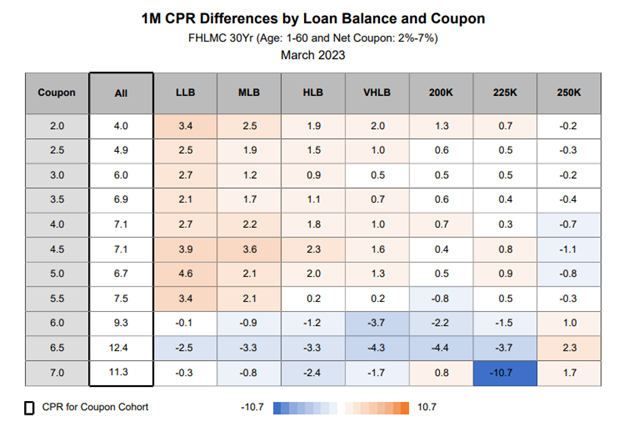
While each report provides a monthly reference point for pay-up analysis, a sequence of monthly reports may also have the potential to observe and track changes in mortgage prepayment speeds under different macroeconomic conditions.
During the beta period, we will continue to enhance and enrich the “Specified Pool Prepayment Trends” reports. We look forward to your comments, suggestions and feedback to make these reports more informative and useful to you.
Please contact us at support@ad-co.com or (212) 274-9075 with any questions or suggestions.
The S-Curve Archives
-
 Products
Andrew Davidson & Co., Inc (AD&Co) is pleased to announce the beta release of a new monthly report series titled “Specified Pool Prepayment Trends,” which aims at showing market prepayment trends for specified agency pools in support of pay-up analyses by investors, traders, and alike.
-
 Products
Andrew Davidson & Co., Inc (AD&Co) is pleased to announce that Polypaths LLC supports AD&Co’s Auto LoanDynamics Model (Auto LDM) providing prepayments, defaults and losses on auto loans and securities.
-
 Events
The Structured Finance Association hosted SFVegas 2023 (February 26 - March 1), a broad capital markets conference with thousands of attendees in Las Vegas. Andrew Davidson & Co. Inc. (AD&Co) was a sponsor focused on the mortgage sector. As we engaged with clients and policy leaders, a few themes emerged: Data, Expanding Access Safely, Ginnie Mae Servicing and Auto Loan Performance.
-
 Products
Andrew Davidson & Co., Inc (AD&Co) is pleased to announce the official release of the LoanDynamics Module in Kinetics, AD&Co's new modular platform for running AD&Co analytics via a desktop application, web browser, or REST API. The LoanDynamics Module is the latest way to run the LoanDynamics Model, allowing users to perform sensitivity analysis, validation testing, and scenario analysis in a modern, user-friendly application.
-
 Thoughts
Recently the Federal Housing Finance Agency (FHFA) announced some upcoming changes related to the use of new credit scores, FICO 10T and VantageScore 4.0 by Fannie Mae and Freddie Mac. “FHFA expects that implementation of FICO 10T and VantageScore 4.0 will be a multiyear effort. Once implemented, lenders will be required to deliver both FICO 10T and VantageScore 4.0 credit scores with each loan sold to the Enterprises”.[1] This announcement will impact the entire mortgage ecosystem.
-
 Thoughts
January is National Mentoring Month which is very appropriate since it coincides with the time when we typically set out our goals and intentions for the New Year. Organizations are embracing mentoring programs and these programs have indeed become a strategic imperative for many. There are many benefits to mentorship and it's easy enough to comprehend. The individuals involved in a mentoring relationship and the organizations that choose to sponsor a mentoring program all are likely to benefit.
-
 Thoughts
Homeownership is the largest source of wealth accumulation and inter-generational wealth transfer for the working and middle class. However, the history of racial discrimination (it was actually legal to discriminate by race in housing until the Fair Housing Act of 1968), suggests that we have a continuing responsibility to ensure fair access to housing and housing finance.
-
 Thoughts
Dear Friends,
As Andrew Davidson & Co., Inc. (AD&Co) reaches its 30-year milestone, I reflect on two seemingly contradictory ideas: Firms need experience to guide clients through difficult times but sometimes it is necessary to discard past practices to achieve breakthroughs.
-
 Thoughts
For many people, having accessible transportation (a car, for example) is necessary. Most U.S. people live in areas without adequate public transportation and require vehicles to access jobs, healthcare, and groceries.
-
Thoughts
As interest rates rise and fewer loans with refinancing incentive remain, other factors are primed to play a larger role in determining prepayment speeds in the coming months (and perhaps years). Turnover, the rate at which people move, is the most cited of these factors. In this blog post, we’ll consider two other potential drivers: curtailments, or partial prepayments, and mortgage payoffs that don’t involve taking out a new loan.