

Welcome to The S-Curve
Now you will be able to receive the latest announcements, product updates, and our insights on the mortgage market in real time.
The name of the blog, the S-Curve, is a reflection of our logo and the central feature of our prepayment model. S-curves are seen in nature in many phenomenon, from population growth to prepayment and default models. Our first S-curve, in the early 1990s, used the arctangent function, then piece-wise linear functions, and evolved over time to be more complex and vary by FICO, loan size and LTV. This evolution encapsulates both the timeless nature of fundamental relationships and constant innovation to describe them better over time.
We hope you find the information useful and we look forward to your feedback.
-
 Combatting the Effects of Algorithmic BiasThoughts
Homeownership is the largest source of wealth accumulation and inter-generational wealth transfer for the working and middle class. However, the history of racial discrimination (it was actually legal to discriminate by race in housing until the Fair Housing Act of 1968), suggests that we have a continuing responsibility to ensure fair access to housing and housing finance.
The homeownership rate for white Americans has averaged 70-75% over the last 25 years but only 40-50% for black Americans. In fact, the gap has widened over this period.
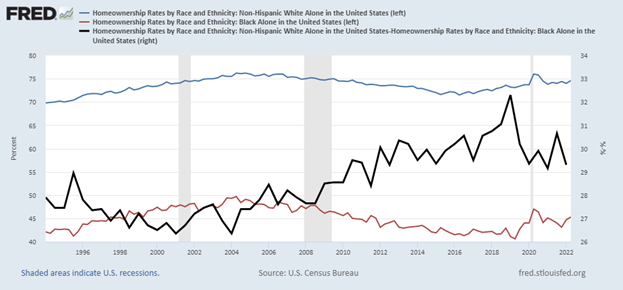
What is Equitable Housing Finance, and how do we make progress towards it?
The issues of economic opportunity, and geographic and housing inequality, are long-standing and varied. But as practitioners in mortgage risk and analytics, we focus on data, assessing risk and equal access to mortgage credit. Households of moderate means generally use credit to buy their first home so we must consider credit access and the quantitative process carefully, especially in the context of artificial intelligence and unintentionally biased algorithms.
The premise is simple: Use the same comprehensive set of financial data for everyone and apply it fairly.
Going beyond credit scores
Most people know about credit scores, which serve as the principal metric used for credit decisioning. What if it turns out that credit scores don’t reflect all relevant consumer financial data? What if this data gap has grown over time, and what if it’s larger for targeted groups like minorities and low-income families?
To the degree that mortgage decisioning models omit relevant data, they become less accurate. To the degree that such omissions are concentrated among certain groups, these models will contain algorithmic bias.
Consumer credit scores were created in the 1950s, and the Equal Credit Opportunity Act of 1974 ensured they could not include discriminatory information. The FICO formulation commonly used for mortgage credit today was built about 2004 and it correlates well to the likelihood of short-term delinquency.
However, financial data is now available that is materially relevant to consumer credit performance, but is not included in credit scores. This data is generally more significant for renters and underserved populations, those with smaller traditional financial footprints. Such indicators include consumer credit card balances, telecom/utility payment data, and free cash flow from bank accounts.
The mortgage ecosystem is beginning to work towards using expanded consumer financial data. AD&Co is acquiring this data and improving our analytics make mortgage decisioning both more accurate and more fair.
Working through public policy
Leveraging new data, advancing national standards, and broadly implementing improved decisioning are not automatic. Most mortgage lending is federally connected (GSEs, FHA/VA, banks), and compliance standards are universally applied. This occurs in part because the mortgage market contains inherent information asymmetries and social externalities around fairness and stability. The confluence of finance and policy leads us to combine our analytic efforts with actively engaging with federal counter-parties and in the policy debate. This includes focusing on how to integrate new data sources into mortgage decisioning on a national scale as a means to improve accuracy and fairness.
The S-Curve Archives
-
 Events
At Andrew Davidson & Co., Inc. (AD&Co), our dedication to Diversity, Equity, and Inclusion (DEI) has been a cornerstone of our values. We established our DEI Committee in 2020, following the tragic murder of George Floyd. Despite the evolving landscape, including the recent U.S. Supreme Court decision impacting affirmative action in higher education, we remain steadfast in our commitment to fostering an inclusive environment that strengthens both our employees and the company.
-
 PodcastTune in to Eknath Belbase's interview with Michelle Stepien Breier & Richard Cooperstein as they discuss their latest Pipeline article “Improving Mortgage Data: A Data Exchange for the Mortgage Ecosystem.”
 -
 Events
Andy and I recently attended AmeriCatalyst ‘Going to Extremes’ Climate, Housing and Finance Leadership Summit in Washington, D.C., a fantastic conference on all things related to climate risk and the housing ecosystem. While going over all the great speakers and broad expertise represented there would take a novella, I want to connect a few key ideas discussed there to our ongoing efforts in this area.
-
 Events
At the recent AmeriCatalyst ‘Going to Extremes’ Climate, Housing and Finance Leadership Summit, I presented a session on how risks related to weather-related losses impact the housing finance system.
-
 Products
Andrew Davidson & Co., Inc (AD&Co) is thrilled to announce an expanding relationship with a Third-Party Vendor! AD&Co enjoys working with countless analytical providers to offer our clients seamless solutions and we would like to welcome Milliman M-PIRe™ to the team!
-
 Events
The Federal Home Loan Bank of San Francisco directed the Urban Institute to develop innovative and actionable ideas to close the gap between white and black homeownership rates, which is as wide today as before the Fair Housing Act, enacted 60 years ago. Homeownership is crucial to a fairer society because working and middle-class families most commonly create inter-generational wealth by owning homes with amortizing mortgages.
-
 Events
The Data Foundation of Mortgage Finance
Homeownership is the largest source of wealth accumulation and inter-generational wealth transfer for the working and middle class. However, the non-interest cost of financing is always an obstacle for first-time and low-wealth buyers, and underserved populations.
-
 Thoughts
In this blog post, we used the recently updated Mortgage Market Statistical Annual to examine the dynamics of residential loan origination by state and by market segments and highlight important trends.
-
 Products
Andrew Davidson & Co., Inc. (AD&Co) is pleased to announce the official release of Kinetics v1.10, the latest update to AD&Co’s modular platform for running the AD&Co suite of analytics. This update introduces the Multifamily LoanDynamics Module, the newest way to run Multifamily LoanDynamics Model (LDM). Investors, servicers, insurers and lenders can leverage this new module to better understand the prepayment and credit risk of their multifamily mortgage portfolio.
-
 Events
Andrew Davidson & Co., Inc. (AD&Co) held a webinar on June 8th entitled “Lessons Learned: Insights for Managing the Interest Rate Risk of Banks.” Mickey Storms from our Alliances and Policies team, Alex Levin from our Financial Engineering team and Andrew Davidson were featured speakers.