

Welcome to The S-Curve
Now you will be able to receive the latest announcements, product updates, and our insights on the mortgage market in real time.
The name of the blog, the S-Curve, is a reflection of our logo and the central feature of our prepayment model. S-curves are seen in nature in many phenomenon, from population growth to prepayment and default models. Our first S-curve, in the early 1990s, used the arctangent function, then piece-wise linear functions, and evolved over time to be more complex and vary by FICO, loan size and LTV. This evolution encapsulates both the timeless nature of fundamental relationships and constant innovation to describe them better over time.
We hope you find the information useful and we look forward to your feedback.
-
 Andrew Davidson Featured on the One On One with Greg SherEvents
Andrew Davidson recently joined NFM Lending’s Greg Sher on the One On One podcast to discuss our recent white paper, “The Impact of Moving Away From the Tri-Merge Standard.”
In the conversation, Andrew shares insights on the evolving credit score landscape and what these changes could mean for mortgage modeling and risk assessment.
You can listen to the full discussion here:
-
 Impressions from SFVegas and OB Summit 2026Events
AD&Co recently sponsored and attended SFVegas 2026 and Optimal Blue Summit 2026. This post shares the AD&Co team's unique perspectives and key takeaways from attending both conferences.
The New Non-Agency Model, Real Estate Exposure to Climate-Related Hazards & Escrow Analysis (Eknath Belbase)
Daniel and I recorded a Exchange Live: Tech Odyssey podcast on Kinetics and the upcoming release of LDM v4.0. The 30-minute audio and accompanying slides are available on demand. We focused on DSCR/prepay penalty, along with the addition of climate.
My panel on climate risk and property values went well – this year the focus shifted a bit to resilience, and the opportunity to reduce the rate of insurance increases by putting money up front into strengthening homes. Several states are funding the initial outlay required in pilot programs as part of insurance affordability initiatives (including Deep South states). David Zhang of MSCI started off the discussion with a tally of damages from physical risk sorted into quintiles of cost (measured against home value). The top quintile is already at a mean of 55bps per year of loss (these are only losses from weather events of scale and insurance needs to include costs such as fires starting from appliances or flooding from sewer back-ups).
Finally, we learned that Cotality has a database of property tax histories on all U.S. single-family homes and is working on an approach to forecast taxes going forward, so our vision of a full escrow-conditioned HPA and LDM is within reach.
Contact us for more information on LDM v4.0.
Key Takeaways (Daniel Swanson)
It was great to see so many familiar faces and to see the conference booming (though also a bit foreboding – the last time it was so packed, there was a crisis shortly thereafter). Here are a few key takeaways I had from talking to different people.
Non-QM
- There is a lot of interest in non-QM from many sophisticated participants
- Analyzing new loans is complicated and most people are not taking advantage of all the information in the deals
Climate
- State-level behavior is changing, particularly FL payups, perhaps due to taxes and insurance (that link is hard to prove)
- Servicers are starting to care about T+I for several different reasons (escrow float=positive, delinquency risk=negative)
Credit Scores
- Participants are mostly worried about disruption to their process when thinking about credit scores rather than performance
AI
- Everyone is thinking about AI, whether they are talking about it or not (and there are plenty of people talking about it)
How AD&Co and Optimal Blue Are Transforming Pipeline Risk Management for Loan Originators (Yvonne Chen)
At the Optimal Blue Summit 2026, we connected with loan originators and our alliance partners at Optimal Blue to discuss the evolving challenges in the mortgage origination sector. The conversations and conference sessions reinforced the patterns we've been seeing: Origination is a thin margin business, and originators must carefully manage the uncertainty and financial risks from locking rates at the beginning of the application process through to loan sale. Lenders manage their pipelines across agency and non-agency loan products while simultaneously borrowing closing funds and hedging to protect their profit margins – all while contending with interest rate volatility, fallout risk, basis risk in non-QM products, and borrower renegotiation. Fallout rates have climbed in recent years as borrower behavior shifts and competition intensifies in a low-volume market, making accurate pipeline risk management more critical than ever. Optimal Blue and AD&Co see the persistent need for the kind of sophisticated analytics that we can provide to help lenders stay ahead of these challenges.
AD&Co was featured on a panel where Matteo Caracciolo-King had the chance to present a first look at our insights on consumer behavior in the application process based on Optimal Blue’s national application data set. Originators were keenly interested in forecasting application stage transition probabilities, which vary over time and across interest rates, as well as the kind of financial risk metrics that AD&Co can provide. The conference confirmed our view that, as pipeline hedging grows more complex, particularly with a fast-growing non-agency market, we see a meaningful opportunity to help originators strengthen their risk management through advanced analytics integrated into the Optimal Blue platform they already rely on.
-
 FRED Adds AD&Co’s GSE-and-Borrower-Option-Adjusted Spreads for CRT IndicesNews
AD&Co US Mortgage High Yield Indices
The Federal Reserve Economic Data (FRED) portal, housed by the Federal Reserve Bank of St. Louis, has been publishing AD&Co’s CRT indices since 2019. These series posted under the overall name of “US Mortgage High-Yield” include total return rates and credit and option-adjusted spreads (crOAS) – a projected return’s spread over Treasury (in the past, Libor). These series are available going back to 2014-end and tiered by CRT initial supports.
Tier 0 includes all CRTs with under-25 bps support; Tier 1 bonds have supports exceeding 25 bps, but not 95 bps; Tier 2 has support from 95 bps to 175 bps; Tier 3 – from 175 bps to 375 bps, and, finally, Tier 4 – above 375 bps. The actual bond’s name (As, Ms, or Bs) that matches each tier can vary over time and between Fannie Mae’s CAS and Freddie Mac’s STACR transactions. We define Mid-Tier as the aggregation of Tiers 1 through 3. A CRT to be included in an index must have a factor of 0.25 or higher.
While actual rates of investment return are computed model-free, crOAS levels come from the AD&Co model. Importantly, the crOAS indices that date back to 2014 do not account for the GSE call option embedded in a CRT and therefore overstate the expected return. See, for example, index CROASMIDTIER for Mid-Tier or index CROASTIER0 for Tier 0; the latter currently shows crOAS of about 600 bps.
What is New?
Over the last couple of years, AD&Co developed a model to account for embedded GSE calls. Most CRTs are now issued with a five-year call and a cleanup call. Exercised in the interest of the GSEs, those options reduce investor return. Our December 2024 Quantitative Perspectives[1] laid out the theoretical foundation of our methods. A subsequent September 2025 Pipeline article[2] listed results of the production analysis across the entire CRT cash market.
We have been using the new method in our CRT Monitor monthly publication for the last several months. We have also started sending the new series to FRED, which has adopted it with an announcement. The new crOAS series goes back only to June 30, 2025, and is reported by the same tiers as the previously computed ones. To indicate the difference in the series, the new series contains “GSE and Borrower Options-Adjusted Spread” in the names. A screenshot of FRED’s onboarding, showing all the indices together, is seen below.
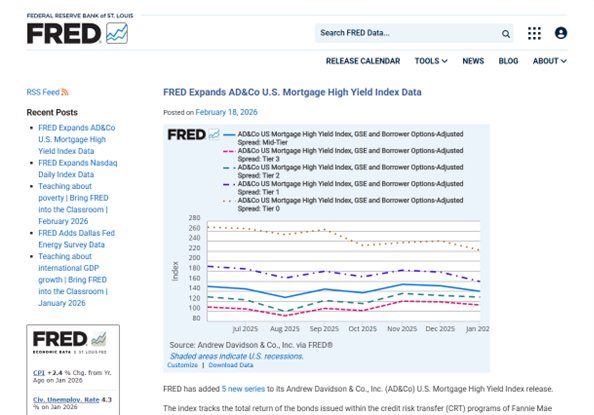
Source: FRED As expected, the more protected CRTs are priced at tighter, more realistic, crOAS levels. They never reach many hundreds of basis points when the GSE option is accounted for.
[1] A. Levin and N. Salwen, Valuation of Credit Risk Transfer with Embedded Calls, Quantitative Perspectives, Dec 2024.
[2] A. Levin, Comparative Valuation of CRTs with and without Embedded GSE Calls, Pipeline 191, Sep 2025.
-
 The Impact of Moving Away From The Tri-Merge StandardThoughts
In July 2025, the US Federal Housing Finance Agency (FHFA) announced that the government-sponsored entities (the Enterprises or GSEs), Fannie Mae and Freddie Mac, would permit lenders to choose between Classic FICO and VantageScore 4.0 credit score models for loans sold to the GSEs. FHFA also stated in a social media post that the tri-merge standard would be maintained for mortgage underwriting. Nevertheless, some mortgage industry stakeholders recommend moving away from the tri-merge standard for GSE mortgages in favor of a single or bi-merge report standard.
Andrew Davidson & Co., Inc. (AD&Co) has analyzed the potential impact on the mortgage ecosystem of changing the credit score tri-merge standard to a bi-merge or a single-score standard. The analysis is based on an examination of a unique data set of VantageScore 4.0 credit scores of a very broad range of consumers constructed from data provided by the Nationwide Consumer Reporting Agencies (NCRAs): Equifax, Experian, and TransUnion.
Results of the study demonstrated that moving away from the tri-merge standard could potentially increase the risk that originators and consumers score shop during the origination process by choosing the credit score (or lender) that produces the lending outcome they desire. Even in the absence of score shopping, moving from the tri-merge could lead to less accurate pricing and mortgage qualification. Minority1 and lower-scoring borrowers would be more heavily impacted. Ultimately, if investors require higher compensation for greater uncertainty, mortgage rates could be higher for everyone.
Key Findings
Credit score uncertainty and mortgage pricing differences increase under a single or bi-merge standard compared to using the traditional tri-merge standard, which utilizes the median (middle) of three scores.
- Scores based on data from a single NCRA differed from the current tri-merge standard (median of 3 scores) often enough to impact loan pricing in meaningful ways. 35% of the 245 million scored consumers represented by the study data set had at least one score that differed from the tri-merge standard by at least 10 points, 18% had a score that differed from it by at least 20 points, and 7% had a score that differed by 40 or more points.
- For consumers in the 640–779 range, where 20-point differences guarantee a move into a higher or lower GSE pricing bucket (based on Loan-Level Pricing Adjustment categories, or LLPAs), these percentages were even higher. As an example, for a $350,000 GSE loan with a 90% loan-to-value (LTV) ratio, moving between consecutive pricing bins can raise or lower the combined cost of borrowing and mortgage insurance (MI) by $3,000 to $5,000 in present value (PV) over the life of the loan.
- The potential for pricing variances due to reduced information is greater for lower-scoring (those with credit scores of 600–639) and minority borrowers, about a quarter of whom were found in this study to have had at least one credit score that differed from the tri-merge standard by at least 20 points.
- In a non-tri-merge landscape, lending and pricing decisions that could be based on different credit scores may create an opportunity for originators to score shop during the origination process by choosing the credit score that produces the lending outcome they desire; consumers choosing between lenders would also, implicitly, be shopping for the best score outcome. Based on the study, about 9% of all consumers (and 11% of those in the 640–779 range) could increase their purported credit score by 20 or more points from what the tri-merge standard would otherwise show.
- Establishing a score cutoff such as 700 to determine whether a tri-merge is required does not eliminate the existence of meaningful score discrepancies.
Analytical Results
Table 1 describes the raw score differences that were observed between individual credit scores for a consumer, when each score is based on data from a single NCRA. Underlying data differences between the NCRAs arise for multiple reasons, including timing differences, processing differences, and acquisition of unique data elements that the others do not have. Each row in Table 1 shows the percentage of 2-score pairs that had a difference above a given threshold, in 10-point increments. We see that consumers with median scores in the lower-score bands and minorities had larger score differences in general.
Table 1. Absolute Value Raw 2-Score Differences by Various Consumer Subsets

In Chart 1, the notation “1B” is used to denote the representative credit score under a single-report standard, while “2B” denotes the representative score under the dual-report standard, wherein the two scores are averaged. These scores may be chosen randomly, or picked due to a specific attribute, such as being the highest or lowest. The chart shows the percentage of consumers in the study for which the 1B or 2B score differed from the tri-merge standard (median of 3) by at least 20 points. These results are broken down by median credit score band, and the “furthest” 1B or 2B score is the one that differed most from the median. For example, 18% of consumers in the 700–779 range had at least one score that differed from the tri-merge standard by at least 20 points.
Chart 1. Single Report and Bi-Merge 20+ Differences vs. Tri-Merge Standard

Recently, some in the industry have proposed a hybrid approach based on an initial score threshold of 700. Under this proposal, if the first-pulled score is 700 or higher, it serves as the consumer’s representative score. If the initial score falls below 700, the standard tri-merge process applies, and the median score is used. While Chart 1 above gives a sense of the ramifications for consumers in the 700–779 range (in green), Table 2 below shows how many consumers from the lower range had a maximum score that exceeded the 700 threshold, which, if pulled, would become the consumer’s representative score under this proposal. These numbers are broken down by credit score band. Note that 4% of consumers in the 640–659 range and nearly 8% of consumers in the 660–679 range had a maximum score of 700 or above.
Table 2. Consumers With Tri-Merge Score Below 700

Conclusion
A credit score predicts a consumer's credit risk, and the score may vary based on the data from the three NCRAs; therefore, using the tri-merge score captures the most complete picture of a consumer's risk. Moving to a single score or to a bi-merge approach increases the uncertainty in assessing borrower risk, with direct implications for loan pricing and underwriting outcomes; this uncertainty is greater for minority and lower-scoring borrowers. Compared to tri-merge results, single-bureau and bi-merge scores often produce large discrepancies: 18% of all consumers had a single score that differed from the tri-merge standard by at least 20 points, and 7% had a score that differed from it by 40 or more points. This can cost higher-LTV/lower-score borrowers (or investors in such mortgages) thousands of dollars in mispriced fees and risk. The call to abandon the tri-merge standard could have a meaningful negative impact and may not result in the most optimal outcome in terms of risk and price assessment for consumers or investors.
The full white paper, “The Impact of Moving Away from the Tri-Merge Standard,” can be downloaded here.
1 Consumer credit reports do not include demographic data such as gender, race, age, nationality, relationship status, education, or religion. For the purpose of this study, proprietary and anonymized third-party demographic data was used for evaluation.
© 2026 Andrew Davidson & Co., Inc. All rights reserved. You must receive permission from marketing@ad-co.com prior to copying, displaying, distributing, publishing, reproducing, or retransmitting any of the content contained in this white paper.
This publication is believed to be reliable, but its accuracy, completeness, timeliness, and suitability for any purpose are not guaranteed. All opinions are subject to change without notice. Nothing in this publication constitutes (1) investment, legal, accounting, tax, or other professional advice or (2) any recommendation or solicitation to purchase, hold, sell, or otherwise deal in any investment. This publication has been prepared for general informational purposes, without consideration of the circumstances or objectives of any particular investor. Any reliance on the contents of this publication is at the reader’s sole risk. All investment is subject to numerous risks, known and unknown. Past performance is no guarantee of future results. For investment advice, seek a qualified investment professional. Note: An affiliate of Andrew Davidson & Co., Inc. engages in trading activities in securities that may be the same or similar to those discussed in this publication.
-
Andrew Davidson quoted in Forbes article titled "Rising Home Insurance Costs Push Housing Finance To A Breaking Point"News
As housing faces more climate threats that result in more losses, the insurance program that it sits on is teetering on the brink of collapse. Yet, the home insurance market has three distinct stakeholders that have competing priorities, and today, there is no motivation for a collaborative solution.
Understanding how to strengthen and protect the current structure requires looking at the cost burdens along with the risk for each of those parties.
During the The Extreme Climate, Housing and Finance Leadership Summit hosted by Toni Moss and Americatalyst, Andrew Davidson, the founder and CEO at Andrew Davidson & Co. shared his analysis of this critical situation.
The S-Curve Archives
-
 Thoughts
There has been a flurry of activity in the mortgage markets since the 2018 passage of the Economic Growth, Regulatory Relief, and Consumer Protection Act. This act requires the Federal Housing Finance Agency (FHFA, now known as US Federal Housing) to validate and modernize the credit score models used in the housing finance system. It should be noted that so far, the discourse has been around mortgages sold to the Enterprises (Fannie Mae and Freddie Mac). Ginnie Mae has not provided any guidance on their plans to start using new credit score models.
-
 Events
Andrew Davidson & Co., Inc (AD&Co) proudly sponsored IMN’s 11th Annual Mortgage Servicing Rights (MSR) Forum by Informa at the New York Hilton Midtown. Senior modeler Daniel Swanson joined the “Managing Delinquencies & Forbearance Value” panel in discussing how servicers are adapting to today’s market and the evolving delinquency trends.
-
 Podcast
Tune in to our fourth episode of AD&Conversations with Kevin Lin and Eknath Belbase, our product lead for our Climate model. In this episode, they discuss the new Climate Impact Suite (CIS) pilot project, and Belbase outlines several challenges the team is navigating, including:
-
Podcast
Tune in to our fourth episode of AD&Conversations with Kevin Lin and Eknath Belbase, our product lead for our Climate model. In this episode, they discuss the new Climate Impact Suite (CIS) pilot project, and Belbase outlines several challenges the team is navigating, including:
-
Podcast
Andrew Davidson was invited to speak on Equifax's Market Pulse Podcast titled, "Driving Efficiency and Resilience in the Mortgage Industry" live at the 2025 MBA Annual Convention in Las Vegas.
Andy explains how variations in data files can distort risk assessment, creating a dual risk for lenders: extending credit to borrowers more likely to default while overcharging customers whose risk is overstated.
-
 Thoughts
Our latest Policy Perspective written by Richard Cooperstein offers an analysis of the U.S. housing and mortgage finance markets, focusing on key trends and forward-looking risks. While housing markets are not fully efficient, they do respond to economic imbalances which create opportunities and vulnerabilities. This article explores how demographic shifts, credit access, interest rates, and climate risks shape both housing demand and supply.
Key findings include:
-
Podcast
Join Kevin Lin in a conversation with Richard Cooperstein as they dive into Kinetics, AD&Co's modular platform designed to deliver the full power of our models and analytics; with the flexibility to license only the tools you need.
-
Thoughts
The latest Policy Perspectives paper “Competing Claims in Privatization of Fannie Mae and Freddie Mac” is now available!
Nearly 20 years ago, on September 6, 2008, the GSEs, Fannie Mae and Freddie Mac entered conservatorship. Since that time there have been many proposals to restructure, eliminate or release the GSEs. Once again there is talk about the privatization of Fannie Mae and Freddie Mac.
-
 Thoughts
AD&Co held our annual employee meeting in Detroit, Michigan. In addition to gathering everyone in person to socialize and strategize, we use these annual meetings to learn about different cities, especially with regard to housing market dynamics.
We chose Detroit because the oft-maligned city is undergoing a significant renaissance, and we wanted to explore the area and learn how housing may have played a role in both Detroit’s decline and rebirth.
-
 Products
Andrew Davidson & Co., Inc (AD&Co) is pleased to announce the beta release of MARS+, the next generation of Mortgage Analysis & Reporting System (MARS), which has been in use since 2008 for performance reporting of AD&Co models. MARS+ aims to provide enhanced and advanced capabilities and features for mortgage analysis and reporting.
The new enhancements of MARS+ include: