

Welcome to The S-Curve
Now you will be able to receive the latest announcements, product updates, and our insights on the mortgage market in real time.
The name of the blog, the S-Curve, is a reflection of our logo and the central feature of our prepayment model. S-curves are seen in nature in many phenomenon, from population growth to prepayment and default models. Our first S-curve, in the early 1990s, used the arctangent function, then piece-wise linear functions, and evolved over time to be more complex and vary by FICO, loan size and LTV. This evolution encapsulates both the timeless nature of fundamental relationships and constant innovation to describe them better over time.
We hope you find the information useful and we look forward to your feedback.
-
 The Impact of Moving Away From The Tri-Merge StandardThoughts
In July 2025, the US Federal Housing Finance Agency (FHFA) announced that the government-sponsored entities (the Enterprises or GSEs), Fannie Mae and Freddie Mac, would permit lenders to choose between Classic FICO and VantageScore 4.0 credit score models for loans sold to the GSEs. FHFA also stated in a social media post that the tri-merge standard would be maintained for mortgage underwriting. Nevertheless, some mortgage industry stakeholders recommend moving away from the tri-merge standard for GSE mortgages in favor of a single or bi-merge report standard.
Andrew Davidson & Co., Inc. (AD&Co) has analyzed the potential impact on the mortgage ecosystem of changing the credit score tri-merge standard to a bi-merge or a single-score standard. The analysis is based on an examination of a unique data set of VantageScore 4.0 credit scores of a very broad range of consumers constructed from data provided by the Nationwide Consumer Reporting Agencies (NCRAs): Equifax, Experian, and TransUnion.
Results of the study demonstrated that moving away from the tri-merge standard could potentially increase the risk that originators and consumers score shop during the origination process by choosing the credit score (or lender) that produces the lending outcome they desire. Even in the absence of score shopping, moving from the tri-merge could lead to less accurate pricing and mortgage qualification. Minority1 and lower-scoring borrowers would be more heavily impacted. Ultimately, if investors require higher compensation for greater uncertainty, mortgage rates could be higher for everyone.
Key Findings
Credit score uncertainty and mortgage pricing differences increase under a single or bi-merge standard compared to using the traditional tri-merge standard, which utilizes the median (middle) of three scores.
- Scores based on data from a single NCRA differed from the current tri-merge standard (median of 3 scores) often enough to impact loan pricing in meaningful ways. 35% of the 245 million scored consumers represented by the study data set had at least one score that differed from the tri-merge standard by at least 10 points, 18% had a score that differed from it by at least 20 points, and 7% had a score that differed by 40 or more points.
- For consumers in the 640–779 range, where 20-point differences guarantee a move into a higher or lower GSE pricing bucket (based on Loan-Level Pricing Adjustment categories, or LLPAs), these percentages were even higher. As an example, for a $350,000 GSE loan with a 90% loan-to-value (LTV) ratio, moving between consecutive pricing bins can raise or lower the combined cost of borrowing and mortgage insurance (MI) by $3,000 to $5,000 in present value (PV) over the life of the loan.
- The potential for pricing variances due to reduced information is greater for lower-scoring (those with credit scores of 600–639) and minority borrowers, about a quarter of whom were found in this study to have had at least one credit score that differed from the tri-merge standard by at least 20 points.
- In a non-tri-merge landscape, lending and pricing decisions that could be based on different credit scores may create an opportunity for originators to score shop during the origination process by choosing the credit score that produces the lending outcome they desire; consumers choosing between lenders would also, implicitly, be shopping for the best score outcome. Based on the study, about 9% of all consumers (and 11% of those in the 640–779 range) could increase their purported credit score by 20 or more points from what the tri-merge standard would otherwise show.
- Establishing a score cutoff such as 700 to determine whether a tri-merge is required does not eliminate the existence of meaningful score discrepancies.
Analytical Results
Table 1 describes the raw score differences that were observed between individual credit scores for a consumer, when each score is based on data from a single NCRA. Underlying data differences between the NCRAs arise for multiple reasons, including timing differences, processing differences, and acquisition of unique data elements that the others do not have. Each row in Table 1 shows the percentage of 2-score pairs that had a difference above a given threshold, in 10-point increments. We see that consumers with median scores in the lower-score bands and minorities had larger score differences in general.
Table 1. Absolute Value Raw 2-Score Differences by Various Consumer Subsets

In Chart 1, the notation “1B” is used to denote the representative credit score under a single-report standard, while “2B” denotes the representative score under the dual-report standard, wherein the two scores are averaged. These scores may be chosen randomly, or picked due to a specific attribute, such as being the highest or lowest. The chart shows the percentage of consumers in the study for which the 1B or 2B score differed from the tri-merge standard (median of 3) by at least 20 points. These results are broken down by median credit score band, and the “furthest” 1B or 2B score is the one that differed most from the median. For example, 18% of consumers in the 700–779 range had at least one score that differed from the tri-merge standard by at least 20 points.
Chart 1. Single Report and Bi-Merge 20+ Differences vs. Tri-Merge Standard

Recently, some in the industry have proposed a hybrid approach based on an initial score threshold of 700. Under this proposal, if the first-pulled score is 700 or higher, it serves as the consumer’s representative score. If the initial score falls below 700, the standard tri-merge process applies, and the median score is used. While Chart 1 above gives a sense of the ramifications for consumers in the 700–779 range (in green), Table 2 below shows how many consumers from the lower range had a maximum score that exceeded the 700 threshold, which, if pulled, would become the consumer’s representative score under this proposal. These numbers are broken down by credit score band. Note that 4% of consumers in the 640–659 range and nearly 8% of consumers in the 660–679 range had a maximum score of 700 or above.
Table 2. Consumers With Tri-Merge Score Below 700

Conclusion
A credit score predicts a consumer's credit risk, and the score may vary based on the data from the three NCRAs; therefore, using the tri-merge score captures the most complete picture of a consumer's risk. Moving to a single score or to a bi-merge approach increases the uncertainty in assessing borrower risk, with direct implications for loan pricing and underwriting outcomes; this uncertainty is greater for minority and lower-scoring borrowers. Compared to tri-merge results, single-bureau and bi-merge scores often produce large discrepancies: 18% of all consumers had a single score that differed from the tri-merge standard by at least 20 points, and 7% had a score that differed from it by 40 or more points. This can cost higher-LTV/lower-score borrowers (or investors in such mortgages) thousands of dollars in mispriced fees and risk. The call to abandon the tri-merge standard could have a meaningful negative impact and may not result in the most optimal outcome in terms of risk and price assessment for consumers or investors.
The full white paper, “The Impact of Moving Away from the Tri-Merge Standard,” can be downloaded here.
1 Consumer credit reports do not include demographic data such as gender, race, age, nationality, relationship status, education, or religion. For the purpose of this study, proprietary and anonymized third-party demographic data was used for evaluation.
© 2026 Andrew Davidson & Co., Inc. All rights reserved. You must receive permission from marketing@ad-co.com prior to copying, displaying, distributing, publishing, reproducing, or retransmitting any of the content contained in this white paper.
This publication is believed to be reliable, but its accuracy, completeness, timeliness, and suitability for any purpose are not guaranteed. All opinions are subject to change without notice. Nothing in this publication constitutes (1) investment, legal, accounting, tax, or other professional advice or (2) any recommendation or solicitation to purchase, hold, sell, or otherwise deal in any investment. This publication has been prepared for general informational purposes, without consideration of the circumstances or objectives of any particular investor. Any reliance on the contents of this publication is at the reader’s sole risk. All investment is subject to numerous risks, known and unknown. Past performance is no guarantee of future results. For investment advice, seek a qualified investment professional. Note: An affiliate of Andrew Davidson & Co., Inc. engages in trading activities in securities that may be the same or similar to those discussed in this publication.
-
Andrew Davidson quoted in Forbes article titled "Rising Home Insurance Costs Push Housing Finance To A Breaking Point"News
As housing faces more climate threats that result in more losses, the insurance program that it sits on is teetering on the brink of collapse. Yet, the home insurance market has three distinct stakeholders that have competing priorities, and today, there is no motivation for a collaborative solution.
Understanding how to strengthen and protect the current structure requires looking at the cost burdens along with the risk for each of those parties.
During the The Extreme Climate, Housing and Finance Leadership Summit hosted by Toni Moss and Americatalyst, Andrew Davidson, the founder and CEO at Andrew Davidson & Co. shared his analysis of this critical situation.
-
 Credit Scores and Mortgages – Where Are We?Thoughts
There has been a flurry of activity in the mortgage markets since the 2018 passage of the Economic Growth, Regulatory Relief, and Consumer Protection Act. This act requires the Federal Housing Finance Agency (FHFA, now known as US Federal Housing) to validate and modernize the credit score models used in the housing finance system. It should be noted that so far, the discourse has been around mortgages sold to the Enterprises (Fannie Mae and Freddie Mac). Ginnie Mae has not provided any guidance on their plans to start using new credit score models.
A Timeline of Events
2022
- FHFA announced that VantageScore 4.0 (VS4) and FICO10T had been validated and approved for loans sold to the Enterprises.
- Once implemented, lenders would have to send both FICO10T and VS4 for each loan sold.
- Lenders could use either tri-merge (where credit reports from all three credit reporting agencies are used) or bi-merge credit reporting (where credit reports from any two are used).
2024
- Historical VS4 data was released for the time period 2013 - 2023.
2025
1. The FHFA on July 28, 2025, announced that
i) Both the Classic FICO and VS4 can be used by lenders.
ii) The tri-merge reporting requirement will be followed.To prepare investors for this change, the Enterprises will start providing extra data in the MBS (mortgage-backed securities) disclosure files starting in December 2025. The current credit score field will be renamed “Classic FICO” and the VS4 scores will be reported in a separate field.
Other Proposals
Another proposal floated by some stakeholders is to move to a single bureau score instead of a tri-merge score. This will probably not impact consumers or insurers of lower risk loans, but there might be unwanted consequences for consumers and insurers for higher risk loans, i.e., for higher LTVs and consumers having thin files or lower credit scores.
Impact of the changes
There are three main dimensions that this change will affect.
Dimension 1: Data
- The originator will have to send the score they are pulling downstream to the other market participants.
- The LOS (loan origination systems) will have to adapt to this change.
- The Enterprises will have to report that data to the securities holders.
Dimension 2: Mortgage Analytics
- All mortgage analytical models and applications have historically used Classic FICO. With the addition of VS4, the models will first need an API change so that any new data field(s) can be read into the databases and the models.
- The analytical models will need to know which score is being fed to the models, and the type of score calculation (for example, tri-merge, bi-merge, median, mean).
- The models will then need to be calibrated or refit with the new VS4 data.
- The output would also need to specify the score that was used to generate the model output.
Dimension 3: Gaming
- Gaming can happen both with (i) choice of credit score model, and (ii) choice of which bureau score is used (if the tri-merge standard goes away).
- When originators can observe multiple score models from each of the three bureaus and choose any for underwriting and pricing, they can increase their own profits by sending the highest score to credit investors. (Note that this problem will be exacerbated if the tri-merge standard is replaced by a single-report requirement.)
- This potential for gaming encourages credit investors to raise prices to offset their higher potential risk.
- This second dimension of credit risk uncertainty makes it more difficult to accurately quantify the true risk of the underlying loans.
- We will have to quantify the impact of using the highest score on prepayments, delinquencies, and defaults.
- Lenders might also consider pay-ups in the score they use – the highest or the lowest. Based on the LLPAs, they might decide to use the lowest score as long as the loan gets approved.
Adapting to the Changes
It is an interesting time for those of us who are in the business of quantifying mortgage risk. Credit scores are evolving with new data and new rules about score usage. Adoption by all stakeholders will take time, and we are adapting to the new data and new rules to help our clients prepare as far in advance as possible. Some of these changes are likely to make credit assessment more accurate, but others may raise uncertainty and thus risk.
It’s likely that using a single score lowers the predictive power of delinquency compared with the median of three scores. The GSEs use credit scores to communicate pricing but not to assess risk - they use the full in-file credit reports. They have relied on three full in-file reports for decades and may have to make major changes to their infrastructure if they receive only one.
So how is AD&Co adapting to these changes in the marketplace? First, we are closely following the developments in the markets. Second, as a data-dependent organization, we are actively improving our access to the new data so that we can analyze the changes in risk for our clients. We have already begun testing our prepayment and credit models using the newly available VS4 data to study model fits in various dimensions. We are investigating areas where the fits may have degraded and finding ways to improve model performance. There is a good chance that a new credit score that has different inputs will also lead to model proliferation.
One option that market participants are talking about is that the Enterprises should provide the Classic FICO score in addition to VS4 for a period of time so that model performance with the new score(s) can be observed over that time period. AD&Co is proposing a minimum of two years for the overlap. It should be noted that, at least initially, lenders will not have to report scores from multiple models.
Adopting new scores is a major change in the mortgage market, and loan originators, analytics providers, and secondary market participants are working feverishly to make sure that the transition happens smoothly. We will keep our clients and others updated with the results of our research and any changes to our analytical models (prepayment, credit) because of this adoption.
Reference: Credit Scores | FHFA
FICO 10T and VantageScore 4.0 are trademarks of Fair Issac Corporation and VantageScore Solutions LLC, respectively.
-
 Insights and Takeaways from IMN’s 11th Annual Mortgage Servicing Rights ForumEvents
Andrew Davidson & Co., Inc (AD&Co) proudly sponsored IMN’s 11th Annual Mortgage Servicing Rights (MSR) Forum by Informa at the New York Hilton Midtown. Senior modeler Daniel Swanson joined the “Managing Delinquencies & Forbearance Value” panel in discussing how servicers are adapting to today’s market and the evolving delinquency trends. Rob Landauer, Kevin Lin, and Vivian Li from our Business Development and Financial Engineering teams connected with industry leaders to exchange insights on MSR valuation, risk, hedging, and sensitivity analysis.
Below are some of the themes and takeaways gathered from conversations with attendees and from the AD&Co materials exhibited at the conference.
Rising Delinquency in Recent Vintages
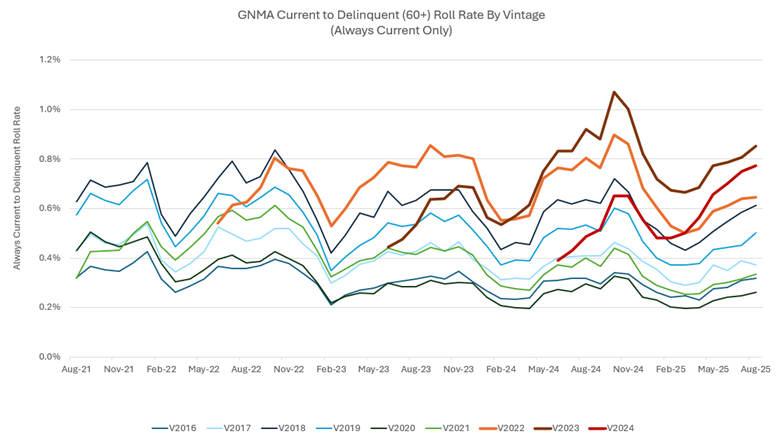
Delinquency was a frequently discussed topic due to increases in delinquency rates in recent vintages. Panelists noted that tax and insurance (T&I) costs continue to increase and along with broader inflation pressures, these factors are driving higher monthly payments; panelists speculated on how much responsibility these higher payments had for the increases in delinquency.
Daniel Swanson shared several slides illustrating this trend, including:
Figure 1. 60+ Days Delinquency Percentage
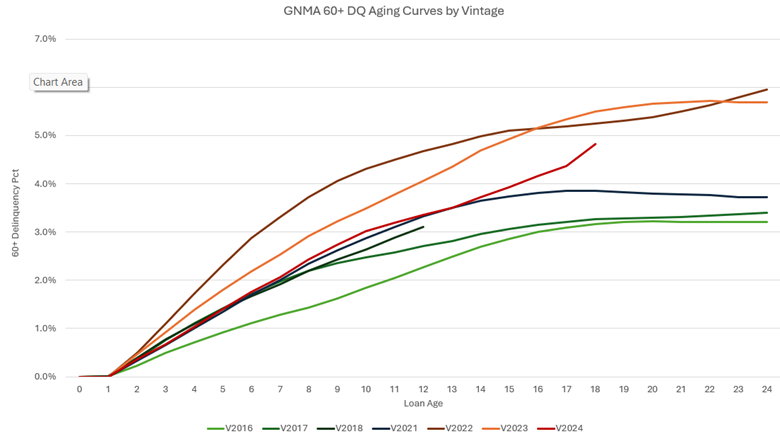
Figure 2. Roll Rate from Always Current to Delinquent
AD&Co’s LoanDynamics Model (LDM) remains one of our most widely used tools for delivering prepayment and credit analytics. In addition, we recently launched our Climate Impact Suite (CIS), which incorporates climate-related costs — in the form of higher insurance premiums — into borrower behavior (prepayments and delinquencies) and home price appreciation/depreciation projections. First, property-level climate risk data provided by geospatial data vendors is translated into homeowners’ insurance premium forecasts to feed as input to CIS, which then enables users to analyze how these climate-driven payment shocks influence delinquencies, prepayments, and MSR valuations. Homes with substantial equity may see increased prepayment activity in response as cost rises, while lower-equity borrowers may be at higher risk of default.
For more details, see Eknath Belbase, “Introducing Pilot Projects for Climate Impact Suite,” The Pipeline 191 (September 2025).
MSR Valuation and Hedging in the current environment
The relative stability of interest rates over the last few years has created a welcoming environment for new opportunistic MSR investors to enter the market. The increased bid from new investors, along with stable rates, has contributed to strong MSR valuations.
However, a panelist raised an important question: Will these transitory investors remain committed if interest rate volatility increases? Some panelists also highlighted concerns about the politicalization of Federal Reserve monetary policy, with potential rate decisions influenced by political considerations rather than inflation and employment mandates. Rate and political uncertainty could put downward pressure on MSR values.
Some companies leverage MSRs as a natural hedge to their loan origination business. Some companies deploy extensive hedging with 100% of the MSR book hedged to control convexity risk. A new hedge instrument, SOFR Swap Futures from Eris, was discussed as an alternative to TBAs and other current hedge instruments because it more directly tracks SOFR risk and provides more efficient use of capital versus swaps.
AD&Co’s Mortgage Servicing Rights Kinetics (MSRK) platform allows users to value servicing assets, visualize rate-risk dynamics, and evaluate hedge strategies.
During the conference, we set up MSRK demos in our booth, highlighting:
Rate-shock sensitivities from –200 bps to +200 bps on MSRs for note rates from 4% to 7.9% (Figure 3).
-
Results emphasized the importance of hedging par and premium MSRs against rising-rate scenarios.
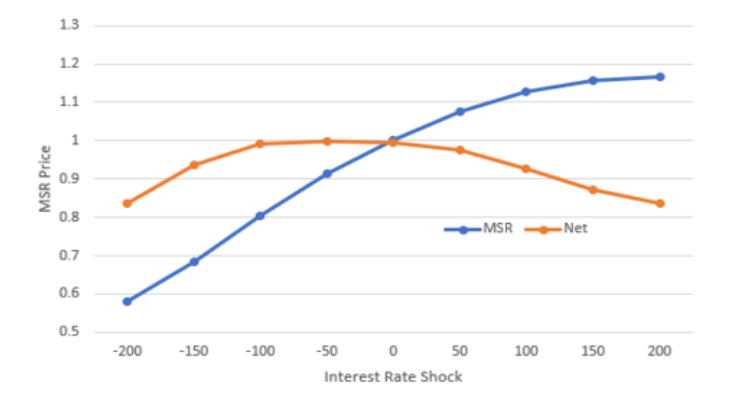
A hedge example applying TBA swap to a 6.7% MSR (Figure 4).
-
The TBA swap overlay helped flatten returns across rate paths and stabilize value.
Figure 3. Impact of Interest Rate Shocks on Different MSR Note Rate Prices

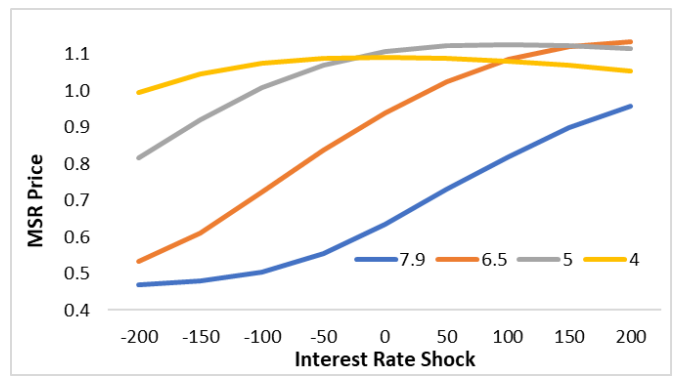
Figure 4. GSE 6.7% MSR: Interest Rate Shocks with TBA Swap
Highlighted topics:
Recapture
Recapture remained one of the most prominent themes—continuing the strong focus seen at last year’s forum. Industry participants highlight recapture as a critical component of MSR valuation and bidding, as market participants are assigning up to a 20% value to this factor. AI and related marketing efforts have put customer retention/recapture at a four-year all-time high. Failure to incorporate the value of recapture in an MSR bid will likely lead to failure. Further, high WAC loans can be more valuable MSR as the refinance propensity generates recapture value.
50-year mortgages
Recently, the administration drew national attention to 50-year mortgages, framing them as a pathway for home affordability and lower monthly payments. The general consensus among conference participants was that 50-year mortgages offer little in the way of promoting home affordability as the increase in overall interest paid by borrowers over the life of the loan more than offsets the relatively modest savings in monthly Principal & Interest (P&I). There were concerns regarding the credit profile of borrowers who cannot qualify for 30-year mortgages but could qualify for 50-year terms. Such products may introduce market distortions or unintended consequences for both credit performance and mortgage securitization markets.
Conclusion
This year’s IMN MSR Forum brought together a wide cross-section of the mortgage servicing ecosystem, fostering discussions on delinquency trends, climate impacts, evolving valuation practices, new policy developments, as well as other topics such as technology, credit score, and more. AD&Co was grateful for the opportunity to participate, share our analytics, and engage with clients and partners. We look forward to continuing these conversations in the months ahead.
-
-
 AD&Conversations: CIS Pilot ProjectPodcast
Tune in to our fourth episode of AD&Conversations with Kevin Lin and Eknath Belbase, our product lead for our Climate model. In this episode, they discuss the new Climate Impact Suite (CIS) pilot project, and Belbase outlines several challenges the team is navigating, including:
-
Helping users become familiar with climate-related casualty data
-
Identifying the most suitable scenarios to use
-
Determining the best way to visualize the results
-
The S-Curve Archives
-
Thoughts
Around 75% of white American families were homeowners in the first quarter of 2020, according to data from the United States Census Bureau. However, only 44% of Black American families owned their homes at the same time.
-
Thoughts
According to a report by the Research Institute for Housing America, climate change risk is rapidly increasing in the housing industry and will continue to demand more attention and regulation in the near future.
-
Thoughts
Mortgage market participants are keenly aware that the Federal Reserve has been scaling back its UST and MBS purchases and factoring the outcomes of its actions on stakeholders across markets.
-
Thoughts
The growing prevalence of artificial intelligence in the mortgage industry is shining a new light on the human biases that have pervaded the industry since its inception. AI is meant to bring fairness and objectivity to mortgage decisions, but it can’t perform fairly if it was built on an unfair system.
-
Products
The LDM v3.0.2 library adds AutoLDM to the v3.0.1 library.
Key benefits include:
-
EventsWe at Andrew Davidson & Co., Inc. (AD&Co) are once again thrilled to celebrate Pride Month, especially the contributions of LGBTQ professionals in the field of finance including affordable housing policy and the GSEs. This year, in addition to celebrating, we are also paying increased attention to the challenges that LGBTQ individuals face, particularly around issues of housing. Our pride in our LGBTQ staff and community sits alongside our concern about discriminatory lending practices, including in mortgages. As of February 2021, for the first time, lesbian, gay, bisexual, transgender, queer, and questioning (LGBTQ) Americans will be protected from housing discrimination under the Fair Housing Act.
-
News
For several years, AD&Co has tracked the total rate of return (TRR) performance of the GSE CAS and STACR CRT in its U.S. Mortgage High-Yield Indices. The AD&Co Mid-Tier index constitutes a broad market measure of the TRR performance of GSE CRT. The related sub-indices segregate the CRT market into 4 index Tiers by attachment point, reflective of the credit exposure of the various classes of underlying CRT ranging from B to M1.
-
EventsWe at Andrew Davidson & Co., Inc. (AD&Co) stand in solidarity with the Asian community and speak out against the xenophobic ignorance that has led to increased racist attacks against Asians. We protest against these hate crimes. This is a time to celebrate the richness that we have gained from the diversity of the Asian culture. We pledge to support the heritage that is part of what makes us American.
-
Events
What does it mean to be mentally healthy? The answer is different for everyone. With all the extra anxiety that many of us have experienced since 2020, whether from uncertainty about COVID-19 or from other experiences that may be new to us, it’s important to acknowledge that it’s alright to not feel alright. Fortunately, there are numerous resources that are available locally, nationally, and in some cases through your workplace or benefits package. We might start by finding out what makes us feel better.
-
Products
Today marks the publication of Chris Widman's Quantitative Perspective, a comprehensive article on the newest member of our LoanDynamics suite, the Auto LoanDynamics Model. Auto LDM will be integrated into vendor systems and AD&Co tools, allowing users to perform analysis on auto loan and ABS positions.