

Welcome to The S-Curve
Now you will be able to receive the latest announcements, product updates, and our insights on the mortgage market in real time.
The name of the blog, the S-Curve, is a reflection of our logo and the central feature of our prepayment model. S-curves are seen in nature in many phenomenon, from population growth to prepayment and default models. Our first S-curve, in the early 1990s, used the arctangent function, then piece-wise linear functions, and evolved over time to be more complex and vary by FICO, loan size and LTV. This evolution encapsulates both the timeless nature of fundamental relationships and constant innovation to describe them better over time.
We hope you find the information useful and we look forward to your feedback.
-
 Thoughts on Stress Tests and CapitalThoughts
As providers of mortgage models for financial institutions, Andrew Davidson & Co., Inc. (AD&Co) enables clients to validate their use of our models and offers documentation describing the conceptual framework of the models, back-testing results, and sample forecasts under a variety of economic conditions. We also work with analytics providers who have incorporated our models to ensure that the models works as intended.
Even with this extensive support, we often do not know how our models will be used. A model that is good for one use may not be appropriate for another. For example, valuation for hedging often is different from valuation for pricing and determining return on equity, or a model built on agency data may not be appropriate for agricultural mortgages. When we are asked or when we are provided with additional information about the client’s use, we can provide additional insight into whether the model is being used appropriately.
The determination of how a model should be employed starts with clarity on how the results of the model will be used. Note that the focus here is not on how reliable the model is or how it performs in sample or out of sample; rather, it is on what actions will be taken based upon the output of the model.
In the case of the Dodd-Frank Act Stress Test (DFAST) and the use of the stress tests to determine the Stress Capital Buffer (SCB), we know how the stress tests are being used by banking regulators and what actions are taken based upon the results of the stress test.
According to the Federal Reserve:1 The original stress tests “played a role in bolstering confidence in the capital positions of U.S. banks during the 2007-09 financial crisis….” This, indeed, is an appropriate use for a system-wide stress test. In a time of crisis, with similar but uncertain risk throughout the financial system, a stress test may provide information about the health of the financial system and individual financial institutions that could not be determined using other measures of capital adequacy.
The Fed goes on to say that capital stress tests, “have become a critical supervisory tool” and are used to integrate “the Board's non-stress regulatory capital requirements with its stress-test-based capital requirements….” Here’s the rub. Did they become a critical supervisory tool and a basis for determining capital requirements because they were the right tool or because they were the tool that was available to the regulators to exercise discretion in setting capital requirements as they sought to replace the Advanced Approaches that utilized bank models?
Starting from basic principles, a stress test is not the best mechanism to establish capital requirements. Conceptually, capital is required to protect depositors and creditors from uncertainty. Expected losses should be built into reserves. Capital then is required for undiversified and unhedged tail risks that are borne by the financial institution. As these risks are associated with uncertainty they may not be reflected in any individual scenario. In fact, due to the availability of a wide range of financial instruments, banks can control the amount of risk in any single scenario at a modest cost and without reducing overall risk.
This creates a quandary for regulators. If they telegraph the detailed stress scenario in advance, institutions will be able to adjust their portfolios to enhance income in those scenarios, thereby reducing their required capital buffer, but not necessarily reducing risk across other potential scenarios. However, if they do not disclose the scenarios in advance, they can be (and have been) accused of being arbitrary.
The use of specific scenarios also creates issues associated with the use of models like AD&Co’s LoanDynamics Model or any model of borrower behavior within the stress test framework. Stress tests by their very nature involve scenarios that either have not occurred in the past or have been very infrequent. Moreover, no two actual stress events are the same. Thus, it is not possible to determine with precision how borrowers will behave. While models may and should provide a general indication of the performance of financial assets under stress, there may be substantial uncertainty.
Once again, the regulators face difficult choices. Should they allow each firm to develop and use their own models and recognize that there will be different results for similar assets under the same scenario at different institutions? Or should they seek consistency in results even in the face of this fundamental uncertainty? Neither solution seems quite right. Capital should reflect model risk as well as other economic uncertainties, so forcing use of a single set of modeling assumptions could increase systemic risk.
While it may seem like the current approach is beneficial if the stress scenario occurs and harmless otherwise, there are substantial costs and missed opportunities associated with the DFA Stress Tests. Firms (and the Fed) spend significant resources on the stress test because they have a direct impact on capital requirements and dividends. Those resources might be better spent on a broader set of risk measurement and risk management activities. Furthermore, stress tests may create a false impression that the banks have sufficient capital to withstand any stress or, even worse, that when stress emerges, that was not envisioned by the regulatory scenarios, such as the rate increases in 2022 and 2023, depositors and investors may have little confidence that the banks can weather the storm.
Even if the current implementation of stress tests isn’t the right approach to determining a capital buffer, can stress tests still be used to determine a capital buffer without revamping the entire capital regime?
A better approach to using stress tests would be to recognize that capital is required to bear a variety of uncertain risks. As such, other than when there is a dominant risk across the entire financial system, a variety of scenarios are required. A better approach would also recognize that interest rate risk in the banking book is not captured by current asset-based capital requirements, which focus on credit risk, scenarios which expose risk from rising and falling rates are also required. The introduction of the exploratory scenarios last year is a partial step in this direction. A better approach would also encourage financial institutions to explore the model risk associated with asset performance without penalizing firms for looking at more conservative scenarios.
This approach would involve five or possibly even ten scenarios to provide a robust evaluation of risk. 5 to 10 scenarios that are defined relative to current conditions that would stress credit, market risks, and interest rates. The scenarios could even have a counter-cyclical flavor. The Fed could choose one for the actual stress test that year (if there continues to be a requirement to have only one scenario) but with the expectation that firms would compute results and manage risk for all the scenarios since they wouldn’t know which one was going to be selected.
In this way, the stress test would operate like an exam where the professor tells you all the possible questions but only selects one or two for the final.
With a framework that includes multiple scenarios that can be consistent over time, stress tests can be a more valuable and reliable tool for determining stress capital requirements. During periods of system-wide stress, scenarios can be developed to bolster financial confidence, as during the Great Financial Crisis. In this way, scenario-based stress tests can be valuable both during and between periods of severe financial stress.
1 “Stress Tests.” Federal Reserve Board - Stress Tests, June 22, 2022. https://www.federalreserve.gov/supervisionreg/stress-tests-capital-planning.htm.
-
 Now Available: AD&Co’s Quantitative PerspectivesThoughts
We’re excited to announce two new Quantitative Perspectives that provide in-depth insights into current market trends and advanced valuation techniques. These papers offer valuable information for mortgage market participants and those involved in credit risk transfer transactions.
Is the New “New Normal” the Old Normal? Understanding Mortgage Rates
Explore why mortgage rates have not followed the expected path after the Fed’s easing cycle and what factors may drive future rate movements. We offer a long-term perspective and discuss how mortgage rates differ from Treasury rates, providing improved insights and benchmarks for market participants.
Valuation of Credit Risk Transfer with Embedded Calls
Learn how to address the challenges of valuing embedded call options in credit risk transfer transactions. Using three different approximation methods, we explore more accurate ways to estimate the market value of these options, highlighting the advantages of each approach.
Both papers will be valuable resources for your work. A login is required for access. If you have any questions or would like to discuss the content in more detail, please contact support@ad-co.com.
-
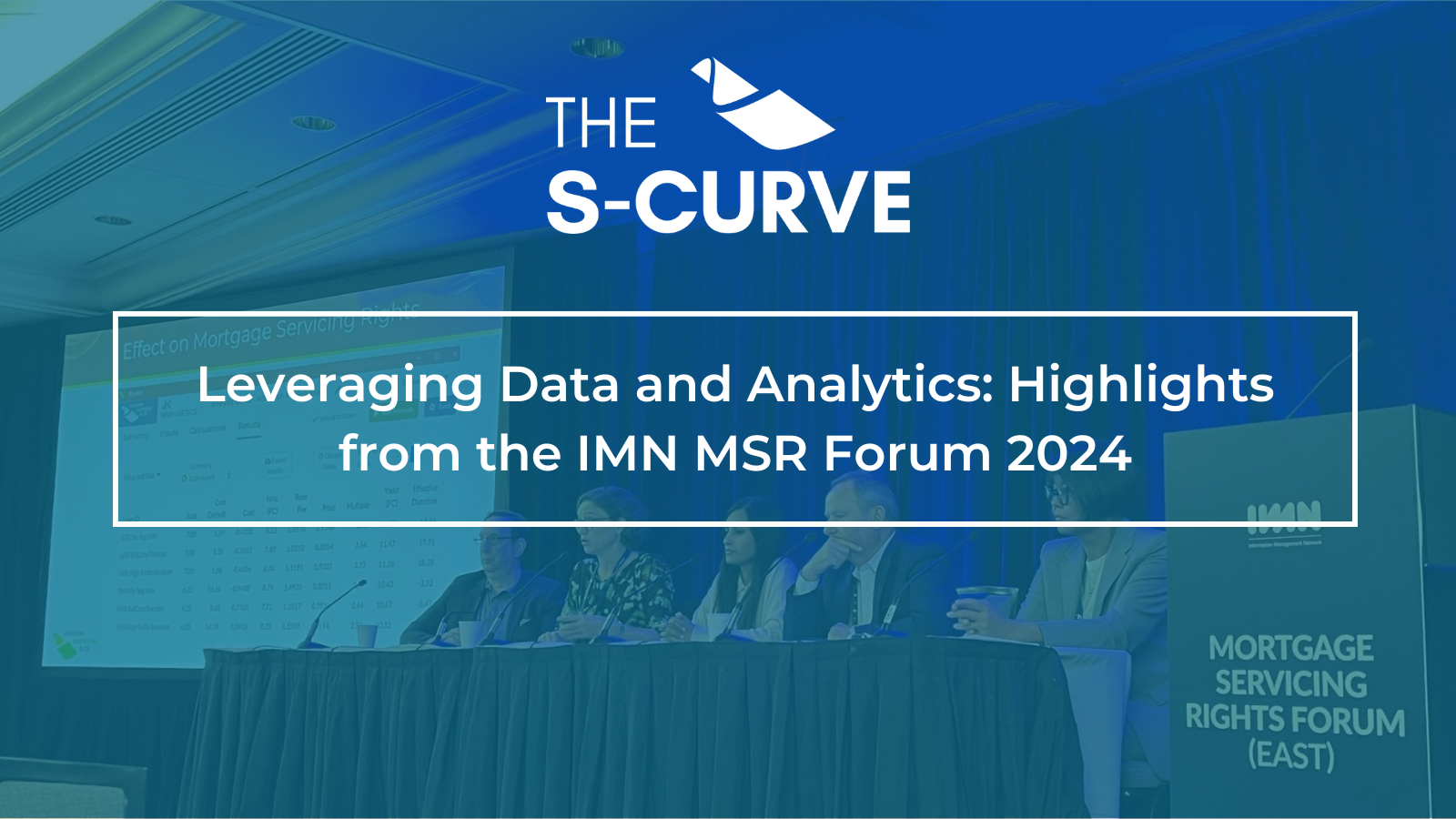 Leveraging Data and Analytics: Highlights from the IMN MSR Forum 2024Events
Andrew Davidson & Co. Inc. (AD&Co) proudly sponsored the Information Management Network (IMN)’s 10th Annual Mortgage Servicing Rights (MSR) Forum, held November 21 - 22, 2024 at the New York Marriott at Brooklyn Bridge. Our servicing expert Richard Cooperstein moderated and I spoke on the panel “Leveraging Trended Data to Enhance Your MSR Portfolio’s Mortgage Prepayment and Credit Modeling.” This panel focused on enhanced consumer data, its impact on delinquencies and prepayments (as shown in our white paper), and the process to bring the data and analytics into decision-making.
Other panels at the event discussed a variety of topics, including the interest rate outlook, macroeconomic factors, climate factors, and their effects on prepayments, escrow, originations, delinquencies, new versus seasoned MSRs, MSR supply and demand, and rate hedging strategies and functionality. The panel discussions underscored the need for a deeper understanding and management of the interest rate and credit risks embedded in the federal mortgage servicing asset. Recapture and the importance of good customer service were recurring themes throughout the conference.
Cautious Optimism for the MSR Market
The overall sentiment regarding MSR assets was a cautious optimism: Despite being a complex asset class, the MSR market remains strong, and people want to buy. Many panelists took the view that due to full employment, a strong GDP, and expectations about the economy and a large and increasing deficit, interest rates in 2025 would see at most a modest decrease before rising again. However, this view was not universally shared, with some pointing to a potential economic downturn and increased defaults being hinted at by delinquency trends in auto credit being close to pre-Covid levels, and the subset of Covid forbearance mortgages that will ultimately default.
For borrowers who already have low mortgage rates, there is limited room for modification; it is interesting to note that one servicer mentioned having some mortgages in foreclosure even with low LTV. Meanwhile, some borrowers bought homes in 2023 hoping to ultimately refinance into lower rates, but the opportunity has not arisen (and might not anytime soon). Finally, due to climate factors and inflation, insurance in some areas is becoming increasingly unaffordable or unavailable. In some regions, such as Florida, some condominium owners are facing massive assessments. One servicer noted that with the current high home prices, most consumers facing high insurance increases can sell their homes. However, there is evidence that when insurance premiums rise to the level of 30-40% of principal and interest, delinquencies also begin to rise. AD&Co’s Climate Impact Suite (currently in beta testing) distinguishes between the effect of climate change on home prices (through Climate Conditioned HPA) and the effect of high premiums on borrower behavior (through Climate Conditioned LDM), with the first effect feeding into the second; if the CLTV remains low, high premiums lead to increased turnover, but if the CLTV becomes high, delinquencies increase.
Uncertainty and the Importance of Prepayment Forecasting
In general, and especially with the new administration coming in, uncertainty was a key theme throughout the forum. It was suggested more than once that the economy may have some curve balls. Regardless – and as always – the ability to forecast prepayment speeds is key for valuing MSR’s. Prepayments determine the total base fee collected on a mortgage, as well as the earnings on escrow and payment float, which have become larger and increasingly important components of MSR valuation due to higher interest rates.
For current coupon mortgages, much depends on the interest rate forecast. For low-rate mortgages, however, it's important to understand the economics of turnover (especially when no rate incentive exists) and predict which borrowers are more likely to prepay at a low rate, such as 3%. The overall low prepayment rate among this set could potentially rise due to a pent-up demand to move, especially with more firms pushing for employees to return to the office.
Many panelists spoke about recapture, which was a prominent theme of the conference: recapture refers to the situation in which the servicer retains the borrower by servicing the new loan as well. Some servicers account for recapture in their valuation, and some use models for predicting recapture rates. The necessity of providing excellent customer service arose in multiple panels as essential for increasing recapture and selling ancillary products while also reducing delinquencies and defaults.
"Know Your Data and Your Portfolio"
One panelist observed that, in the current environment, it is now more important than ever for servicers to “know your data and your portfolio”. The topic was addressed during the AD&Co-moderated panel “Leveraging Trended Data to Enhance Your MSR Portfolio’s Mortgage Prepayment and Credit Modeling”. David Doyle of Sagent first discussed some of the challenges in understanding the strengths and risks of potential MSR acquisitions, while Gauhar Turmuhambetova of BlackRock outlined the challenges of using dynamic credit bureau data in the valuation of securitized products. Bindiya Jain of Experian described the granular loan-level insights available on their platform and specifically within their mortgage performance dataset. Then I shared research that illustrates how Experian’s trended data attributes may be used to improve mortgage prepayment and delinquency forecasts beyond what may be inferred from a traditional credit score. I also demonstrated through AD&Co’s MSRKinetics application how these improved forecasts would affect the base fee and cost components of MSR valuation for sample GSE and FHA loans, as well as their weighted average lifetimes and duration profiles.
Overall, IMN’s MSR forum provided a rich opportunity to engage with participants in the MSR industry, learn about their views and needs, and explore potential synergies.
-
 AD&Conversations: AD&Co Updates its Home Price Index ModelPodcast
Tune in to Michelle Stepien Breier's interview with Alex Levin & Matteo Caracciolo-King as they discuss their latest Pipeline article “AD&Co Updates its Home Price Index Model.” The interview highlights key points from the article as they share recent updates to the HPI3 model. If you’re intrigued and eager to learn more, hit play or click the link to read the full article!
Login is required to access this Pipeline article.
-
 Revisiting the Capital Treatment of Credit Risk TransferThoughts
With the increasing volumes of Synthetic Risk Transfer (SRT) and Credit Risk Transfer (CRT) along with the discussion of BASEL III, we thought it would be useful to re-issue our comment letter to FHFA on the capital treatment of Credit Risk Transfer.
CRT is not quite the same as either equity or debt from a capital perspective; however, capital rules often attempt to categorize them this way and then add ad hoc adjustments. Our comment letter addressed an appropriate framework for understanding the risk reduction impact of CRT transactions.
The S-Curve Archives
-
 Thoughts
In July 2025, the US Federal Housing Finance Agency (FHFA) announced that the government-sponsored entities (the Enterprises or GSEs), Fannie Mae and Freddie Mac, would permit lenders to choose between Classic FICO and VantageScore 4.0 credit score models for loans sold to the GSEs. FHFA also stated in a social media post that the tri-merge standard would be maintained for mortgage underwriting. Nevertheless, some mortgage industry stakeholders recommend moving away from the tri-merge standard for GSE mortgages in favor of a single or bi-merge report standard.
-
News
As housing faces more climate threats that result in more losses, the insurance program that it sits on is teetering on the brink of collapse. Yet, the home insurance market has three distinct stakeholders that have competing priorities, and today, there is no motivation for a collaborative solution.
Understanding how to strengthen and protect the current structure requires looking at the cost burdens along with the risk for each of those parties.
-
 Thoughts
There has been a flurry of activity in the mortgage markets since the 2018 passage of the Economic Growth, Regulatory Relief, and Consumer Protection Act. This act requires the Federal Housing Finance Agency (FHFA, now known as US Federal Housing) to validate and modernize the credit score models used in the housing finance system. It should be noted that so far, the discourse has been around mortgages sold to the Enterprises (Fannie Mae and Freddie Mac). Ginnie Mae has not provided any guidance on their plans to start using new credit score models.
-
 Events
Andrew Davidson & Co., Inc (AD&Co) proudly sponsored IMN’s 11th Annual Mortgage Servicing Rights (MSR) Forum by Informa at the New York Hilton Midtown. Senior modeler Daniel Swanson joined the “Managing Delinquencies & Forbearance Value” panel in discussing how servicers are adapting to today’s market and the evolving delinquency trends.
-
 Podcast
Tune in to our fourth episode of AD&Conversations with Kevin Lin and Eknath Belbase, our product lead for our Climate model. In this episode, they discuss the new Climate Impact Suite (CIS) pilot project, and Belbase outlines several challenges the team is navigating, including:
-
Podcast
Tune in to our fourth episode of AD&Conversations with Kevin Lin and Eknath Belbase, our product lead for our Climate model. In this episode, they discuss the new Climate Impact Suite (CIS) pilot project, and Belbase outlines several challenges the team is navigating, including:
-
Podcast
Andrew Davidson was invited to speak on Equifax's Market Pulse Podcast titled, "Driving Efficiency and Resilience in the Mortgage Industry" live at the 2025 MBA Annual Convention in Las Vegas.
Andy explains how variations in data files can distort risk assessment, creating a dual risk for lenders: extending credit to borrowers more likely to default while overcharging customers whose risk is overstated.
-
 Thoughts
Our latest Policy Perspective written by Richard Cooperstein offers an analysis of the U.S. housing and mortgage finance markets, focusing on key trends and forward-looking risks. While housing markets are not fully efficient, they do respond to economic imbalances which create opportunities and vulnerabilities. This article explores how demographic shifts, credit access, interest rates, and climate risks shape both housing demand and supply.
Key findings include:
-
Podcast
Join Kevin Lin in a conversation with Richard Cooperstein as they dive into Kinetics, AD&Co's modular platform designed to deliver the full power of our models and analytics; with the flexibility to license only the tools you need.
-
Thoughts
The latest Policy Perspectives paper “Competing Claims in Privatization of Fannie Mae and Freddie Mac” is now available!
Nearly 20 years ago, on September 6, 2008, the GSEs, Fannie Mae and Freddie Mac entered conservatorship. Since that time there have been many proposals to restructure, eliminate or release the GSEs. Once again there is talk about the privatization of Fannie Mae and Freddie Mac.