

Welcome to The S-Curve
Now you will be able to receive the latest announcements, product updates, and our insights on the mortgage market in real time.
The name of the blog, the S-Curve, is a reflection of our logo and the central feature of our prepayment model. S-curves are seen in nature in many phenomenon, from population growth to prepayment and default models. Our first S-curve, in the early 1990s, used the arctangent function, then piece-wise linear functions, and evolved over time to be more complex and vary by FICO, loan size and LTV. This evolution encapsulates both the timeless nature of fundamental relationships and constant innovation to describe them better over time.
We hope you find the information useful and we look forward to your feedback.
-
 Panoramic Capital Podcast: Prepayment Modeling with Daniel SwansonPodcast
Recently, senior credit modeler, Daniel Swanson had the pleasure of speaking with Rob Kessel from the Panoramic Capital Academy podcast titled, “Modeler’s Perspective on Prepayment Modeling.” This podcast is part of the curriculum in Panoramic Capital Academy's capital market course, an accredited 14-week class for capital market professionals, including hedging mortgage pipelines and valuing mortgage servicing rights (MSRs). The discussion covered topics like data gathering, how to forecast speeds in an ever-changing world, validating results and how modeling evolved to include more loan-specific variables.
Click here to listen.
About Panoramic Capital Academy and Consulting
Panoramic Capital Academy and Consulting offers an advanced mortgage capital markets training program, providing accessible and foundational education to the mortgage industry to accelerate careers, improve financial performance, and foster respect in the industry. Panoramic also provides mortgage capital market consulting services.
More information can be found at www.panoramiccap.com.
-
 Real World Data on House Price Impact of Climate RisksThoughts
The earliest paper we found examining the impact of climate risks on house prices was from 2017, which found a relationship between elevation/sea level rise and house price differences.[1]
We built our climate-conditioned HPA model in 2022 based on the idea that an increase in insurance costs would impact house prices (something we had not studied yet) in the same way that an increase of the same size in mortgage rates would impact house prices (something that we were quite familiar with).
The real world evidence for this relationship has been accumulating recently – on October 15, 2024 the Washington Post published an article entitled “Where climate change poses the most and least risk to American homeowners” which contains the following chart (which is based on an analysis of 2 million home sales in Florida since 2000):
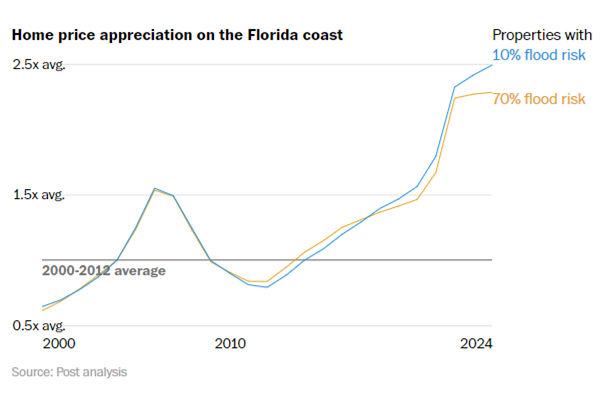
We can see from the lines comparing lower and higher flood risk properties that until very recently, the housing market was not pricing for flood risk. But now there is a clear divergence in price trend.
For the particular case of Florida, there is reason to believe that this trend will strengthen in the near term: until recently, the only reason most people got flood insurance was that they were in a FEMA flood zone and they were required to buy a NFIP policy in order to obtain a mortgage. FEMA flood zone maps are known to be extremely outdated. However, with the accumulation of flooding incidents occurring outside those zones and the publishing of flood risk scores on Zillow, buyers are becoming much more aware of flood risk whether or not a property is in a FEMA zone.
Additionally, the state of Florida is gradually requiring all homeowners buying insurance through Citizens (its FAIR plan for homeowner’s insurance) to also have flood insurance regardless of flood zone status. This requirement started in 2024 for houses priced $600,000 and above, and by January 1, 2027, will extend to all properties insured by Citizens. At the end of 2023, Citizens was the largest insurer in Florida with 15% of all policies and over half a trillion dollars of insured properties.
Furthermore, the different post-event experiences of homeowners who have flood insurance versus those who didn’t is likely to encourage more homeowners – even those not taking a policy through Citizens – to add flood insurance to their property. So flood risk, at least in Florida, is getting closer to being fully priced into real estate values.
While the Washington Post article only discusses flood risk, all borrower costs matter to housing affordability – property taxes, homeowner’s and flood insurance, and the mortgage (leaving aside the psychological costs of nuisance events that don’t rise to the level of filing a claim). To truly capture the potential impact on both house prices and borrower behavior of all these rising costs, a fully climate conditioned approach, combining home prices as well as borrower behavior models (how will prepayment, delinquency, default and loss severity be affected?) is required. This is what our Climate Impact Suite offers.
[1] https://papers.ssrn.com/sol3/papers.cfm?abstract_id=3073842&itid=lk_inline_enhanced-template
-
 AD&Co Welcomes New Third-Party Vendor: Mortgage Capital Trading, Inc. (MCT®)News
Andrew Davidson & Co., Inc (AD&Co) is pleased to announce a new alliance with Mortgage Capital Trading, Inc. (MCT), a leading provider of mortgage capital market solutions.
MCT’s mortgage servicing rights valuation model, MSRlive!, now supports AD&Co’s Agency, Agency+, Non-Agency and Multifamily LoanDynamics Model (LDM), providing clients with forecasts of prepayments, defaults and loss given defaults on agency pools and whole loans, as well as non-agency and multifamily loans and securities, respectively.
Valuation tools are vital to making investment decisions and MSRlive! provides MSR portfolio managers and mortgage bankers with the tools necessary to manage their MSR investments. Coupled with AD&Co’s LDM, clients can now access to a multi-model framework when building and managing their MSR portfolios.
AD&Co would like to thank MCT for their dedication to offering LDM through the MSRlive! platform and servicing our mutual clients to ensure their success.
Are you interested in learning more about accessing LDM via the MSRlive! platform? Please contact Bill Shirreffs at bshirreffs@mctrade.net.
-
 Empowering Our Community: AD&Co's Commitment to DEI and Social ImpactEvents
At Andrew Davidson & Co., Inc. (AD&Co), our dedication to Diversity, Equity, and Inclusion (DEI) has been a cornerstone of our values. We established our DEI Committee in 2020, following the tragic murder of George Floyd. Despite the evolving landscape, including the recent U.S. Supreme Court decision impacting affirmative action in higher education, we remain steadfast in our commitment to fostering an inclusive environment that strengthens both our employees and the company.
On August 15, we came together at our New York office for a meaningful community service project. Partnering with Volunteers of America® Greater New York's Operation Backpack®, our team assembled and distributed backpacks filled with essential school supplies for unhoused students across New York City. These backpacks, which serve elementary, middle, and high school students, included a personal touch: handwritten notes wishing each student a successful school year. We believe every child deserves access to the resources they need to thrive, and we're honored to contribute to easing their transition into a new school year.

AD&Co team assembled to fill backpacks with essential school supplies for unhoused and underprivileged children. Later that day, our team participated in the "Other Side of Wall St." walk led by Kamau Ware of Black Gotham Experience. The walk began with a naming ceremony introducing members of North America's first Free Black Settlement. As we explored the historical impact of these early settlers on New York City, we were struck by the absence of formal recognition for their contributions in the city's landmarks. Kamau's insightful stories and imagery brought to light the rich yet often overlooked layers of history, reminding us of the importance of acknowledging and celebrating all aspects of our past. As a Black woman in mortgage finance, I take pride in working for a firm like AD&Co, which not only supports but actively promotes the values of diversity, equity, and inclusion. Our ongoing efforts are a testament to our commitment to elevating our employees, enhancing our business, and advancing our industry.

AD&Co learning about the history of Manuel Plaza, a beautiful gathering spot dedicated to the impact of African Diaspora in the development of New York. -
 AD&Conversations Improving Mortgage Data: A Data Exchange for Mortgage EcosystemPodcast
Tune in to Eknath Belbase's interview with Michelle Stepien Breier & Richard Cooperstein as they discuss their latest Pipeline article “Improving Mortgage Data: A Data Exchange for the Mortgage Ecosystem.” The interview highlights key points from the article as they share their vision of a mortgage data exchange. If you’re intrigued and eager to learn more, hit play or click the link to read the full article!
Login is required to access this Pipeline article.
The S-Curve Archives
-
 Thoughts
In this blog post, we used the recently updated Mortgage Market Statistical Annual to examine the dynamics of residential loan origination by state and by market segments and highlight important trends.
-
 Products
Andrew Davidson & Co., Inc. (AD&Co) is pleased to announce the official release of Kinetics v1.10, the latest update to AD&Co’s modular platform for running the AD&Co suite of analytics. This update introduces the Multifamily LoanDynamics Module, the newest way to run Multifamily LoanDynamics Model (LDM). Investors, servicers, insurers and lenders can leverage this new module to better understand the prepayment and credit risk of their multifamily mortgage portfolio.
-
 Events
Andrew Davidson & Co., Inc. (AD&Co) held a webinar on June 8th entitled “Lessons Learned: Insights for Managing the Interest Rate Risk of Banks.” Mickey Storms from our Alliances and Policies team, Alex Levin from our Financial Engineering team and Andrew Davidson were featured speakers.
-
 Products
Andrew Davidson & Co., Inc (AD&Co) is pleased to announce the beta release of a new monthly report series titled “Specified Pool Prepayment Trends,” which aims at showing market prepayment trends for specified agency pools in support of pay-up analyses by investors, traders, and alike.
-
 Products
Andrew Davidson & Co., Inc (AD&Co) is pleased to announce that Polypaths LLC supports AD&Co’s Auto LoanDynamics Model (Auto LDM) providing prepayments, defaults and losses on auto loans and securities.
-
 Events
The Structured Finance Association hosted SFVegas 2023 (February 26 - March 1), a broad capital markets conference with thousands of attendees in Las Vegas. Andrew Davidson & Co. Inc. (AD&Co) was a sponsor focused on the mortgage sector. As we engaged with clients and policy leaders, a few themes emerged: Data, Expanding Access Safely, Ginnie Mae Servicing and Auto Loan Performance.
-
 Products
Andrew Davidson & Co., Inc (AD&Co) is pleased to announce the official release of the LoanDynamics Module in Kinetics, AD&Co's new modular platform for running AD&Co analytics via a desktop application, web browser, or REST API. The LoanDynamics Module is the latest way to run the LoanDynamics Model, allowing users to perform sensitivity analysis, validation testing, and scenario analysis in a modern, user-friendly application.
-
 Thoughts
Recently the Federal Housing Finance Agency (FHFA) announced some upcoming changes related to the use of new credit scores, FICO 10T and VantageScore 4.0 by Fannie Mae and Freddie Mac. “FHFA expects that implementation of FICO 10T and VantageScore 4.0 will be a multiyear effort. Once implemented, lenders will be required to deliver both FICO 10T and VantageScore 4.0 credit scores with each loan sold to the Enterprises”.[1] This announcement will impact the entire mortgage ecosystem.
-
 Thoughts
January is National Mentoring Month which is very appropriate since it coincides with the time when we typically set out our goals and intentions for the New Year. Organizations are embracing mentoring programs and these programs have indeed become a strategic imperative for many. There are many benefits to mentorship and it's easy enough to comprehend. The individuals involved in a mentoring relationship and the organizations that choose to sponsor a mentoring program all are likely to benefit.
-
 Thoughts
Homeownership is the largest source of wealth accumulation and inter-generational wealth transfer for the working and middle class. However, the history of racial discrimination (it was actually legal to discriminate by race in housing until the Fair Housing Act of 1968), suggests that we have a continuing responsibility to ensure fair access to housing and housing finance.